

The Benefits of Early Orthodontic Intervention for Kids
Key Takeaways
- The Australian Society of Orthodontists recommends a first evaluation by age 7;
- Phase 1 treatment typically lasts between 10 and 15 months;
- Early care may reduce the likelihood of tooth extractions or invasive jaw surgery later;
- Dr Nick personally oversees every appointment for children at our Chermside and Spring Hill locations.
Why Early Orthodontic Intervention Matters More Than Most Parents Realise
Early orthodontic intervention is a proactive phase of treatment that guides jaw growth and creates space for permanent teeth while a child is still in the mixed dentition stage, typically between ages 6 and 10.
Here is what you need to know at a glance:
- Who it is for: Children aged 6 to 10 with developing bite problems, crowding, crossbites, underbites, or harmful oral habits
- When to act: The Australian Society of Orthodontists recommend a first evaluation no later than age 7
- How long it takes: Phase 1 treatment typically lasts 10 to 15 months, followed by a monitoring period before any further care
- What it can prevent: Tooth extractions, jaw surgery, and more complex treatment later in adolescence
- Three possible outcomes after a first visit: No treatment needed, a monitoring programme, or early active treatment
Many parents assume orthodontic treatment is something to think about when their child is a teenager. In reality, growth-guided approaches are often most effective during early childhood, when a specialist can assess jaw development and guide emerging teeth more easily.
The bones are most flexible in early childhood. That flexibility is a clinical advantage. Addressing a crossbite, a narrow upper jaw, or a protruding lower jaw at age 7 or 8 is a fundamentally different process than attempting the same correction at 14. In some cases, waiting means a problem that was straightforward to intercept becomes one that requires surgery or extraction.
This guide explains the signs to watch for, the conditions that respond best to early care, and what a Phase 1 evaluation actually involves at NK Orthodontist.
I am Dr Nick, a Specialist Orthodontist with over 30 years of experience and a particular clinical interest in early orthodontic intervention for children at my Brisbane practices in Chermside and Spring Hill. Over my career, I have treated more than 11,500 patients and seen first-hand how timely interceptive care may help simplify a child’s long-term orthodontic needs.
What is early orthodontic intervention?
Early orthodontic intervention is a targeted treatment phase designed to address specific dental and skeletal issues while a child still has baby teeth. This stage, often called Phase 1 or interceptive orthodontics, typically begins between the ages of 6 and 10. We use this window of time to leverage the natural growth of the jaw, making corrections that would be far more difficult once the facial bones have hardened.
At this stage, children are in “mixed dentition,” meaning they have a combination of primary (baby) teeth and newly erupted permanent (adult) teeth. By starting early, we can influence how the jaw grows and how permanent teeth emerge. This proactive approach aims to simplify or even eliminate the need for more invasive procedures later in life.
Our focus for kids under 10 is not necessarily on making the teeth look perfect, but on ensuring the “foundation”—the jaw and the dental arches—is correctly aligned. This sets the stage for a healthier mouth and a more straightforward second phase of treatment during the teenage years.
How Phase 1 differs from comprehensive care
Phase 1 treatment focuses on the skeletal structure and the relationship between the upper and lower jaws. We are essentially “guiding the traffic” of the emerging teeth and the growing bone. This phase usually involves specific appliances like expanders or partial braces to correct functional issues like crossbites or severe crowding.
In contrast, Phase 2, or comprehensive care, usually begins around age 12 or 13 once all permanent teeth have erupted. The goal of Phase 2 is to fine-tune the position of every individual tooth to achieve an optimal bite and alignment. While Phase 1 builds the foundation, Phase 2 completes the structure. Not every child who has a Phase 1 evaluation will need immediate treatment; many enter our monitoring programme until they are ready for Phase 2.
The long-term benefits of early orthodontic intervention
One of the most significant advantages of early intervention is the prevention of dental trauma. Children with protruding front teeth are at a much higher risk of chipping or losing those teeth during sports or play. Scientific research on treating prominent front teeth indicates that early treatment can significantly reduce the incidence of incisal trauma.
Furthermore, early care allows us to:
- Maintain or create space: By widening a narrow jaw, we can ensure there is enough room for adult teeth to erupt, which often prevents the need for permanent tooth extractions later.
- Guide jaw growth: We can encourage an underdeveloped jaw to catch up or redirect a protruding jaw, potentially avoiding the need for jaw surgery in adulthood.
- Correct harmful habits: Addressing issues like thumb sucking early prevents permanent deformation of the jaw and teeth.
- Improve oral function: Correcting a bite that does not meet properly can improve chewing and speech.
The optimal age for a first orthodontic evaluation
We recommend that every child has their first orthodontic check-up by age 7. This is the milestone age suggested by the Australian Society of Orthodontists. By age 7, the first permanent molars have usually erupted, establishing the back of the bite and allowing us to evaluate the basic structure of the mouth. This early screening helps identify subtle issues that might not be visible to parents but could lead to significant problems if left unaddressed.
What to expect during the first visit
When you bring your child to our Chermside or Spring Hill practice, the first visit is a relaxed, information-gathering session. Dr Nick will personally perform a clinical assessment to check how the upper and lower jaws fit together and how the permanent teeth are developing. We use digital scans and sometimes X-rays to get a clear picture of what is happening beneath the gums.
This visit is as much for the parents as it is for the child. Dr Nick takes the time to explain his findings and answer any questions you might have. You can book an orthodontic consultation online to secure a time that suits your family’s schedule. There are usually three outcomes: no treatment is needed, the child joins our “observation” group for regular monitoring, or we recommend starting Phase 1 treatment.
The recommended timeline for Phase 1 care
If active treatment is required, Phase 1 usually lasts between 10 and 15 months. This treatment phase focuses on specific developmental goals, such as correcting a crossbite or creating space for erupting teeth. Once those goals are achieved, the active appliances are removed.
| Phase of Care | Typical Duration | Primary Focus |
|---|---|---|
| Observation | Varies (6-12 month checks) | Monitoring growth and tooth eruption |
| Phase 1 (Active) | 10 – 15 Months | Correcting skeletal and functional issues |
| Resting Period | 2 – 4 Years | Retainer wear while waiting for adult teeth |
| Phase 2 (Active) | 18 – 24 Months | Final alignment of all permanent teeth |
After Phase 1, the child enters a “resting period.” During this time, they may wear a simple retainer at night while Dr Nick monitors the eruption of the remaining permanent teeth. This resting period ensures that the progress made in Phase 1 is maintained as the child continues to grow.
Clinical signs that indicate a need for Phase 1 care
While age 7 is the standard for a check-up, some signs may appear even earlier. Parents should keep an eye on how their child uses their mouth. Functional problems, such as mouth breathing, can be a major red flag. Constant mouth breathing often suggests a narrow upper jaw or airway issues, which can impact jaw development and even sleep quality. Expert consensus on pediatric malocclusions links these functional issues to broader health concerns like snoring or short attention spans.
Signs your child needs early orthodontic intervention
Look out for these common indicators that a specialist evaluation is necessary:
- Crossbite: The upper teeth sit inside the lower teeth when the mouth is closed.
- Underbite: The lower front teeth sit in front of the upper front teeth.
- Overbite (Deep Bite): The upper front teeth cover the lower teeth too much.
- Severe Crowding: Teeth are overlapping or erupting in the wrong positions.
- Protruding Teeth: “Buck teeth” that stick out and are at risk of injury.
- Difficulty Chewing: The child frequently bites their cheek or struggles to chew comfortably.
- Asymmetry: The jaw shifts to one side when closing the mouth.
The role of habits in early orthodontic intervention
Habits are a common reason for needing early orthodontic intervention. Prolonged thumb or finger sucking, pacifier use past age 3, and tongue thrusting can all exert pressure on the developing jaw. This pressure can cause the upper jaw to become narrow and the front teeth to flare outward, creating an “open bite” where the front teeth don’t touch even when the back teeth are together. Identifying and correcting these habits early allows the jaw to return to a more natural growth pattern before the issues become permanent.
Common appliances used in interceptive treatment
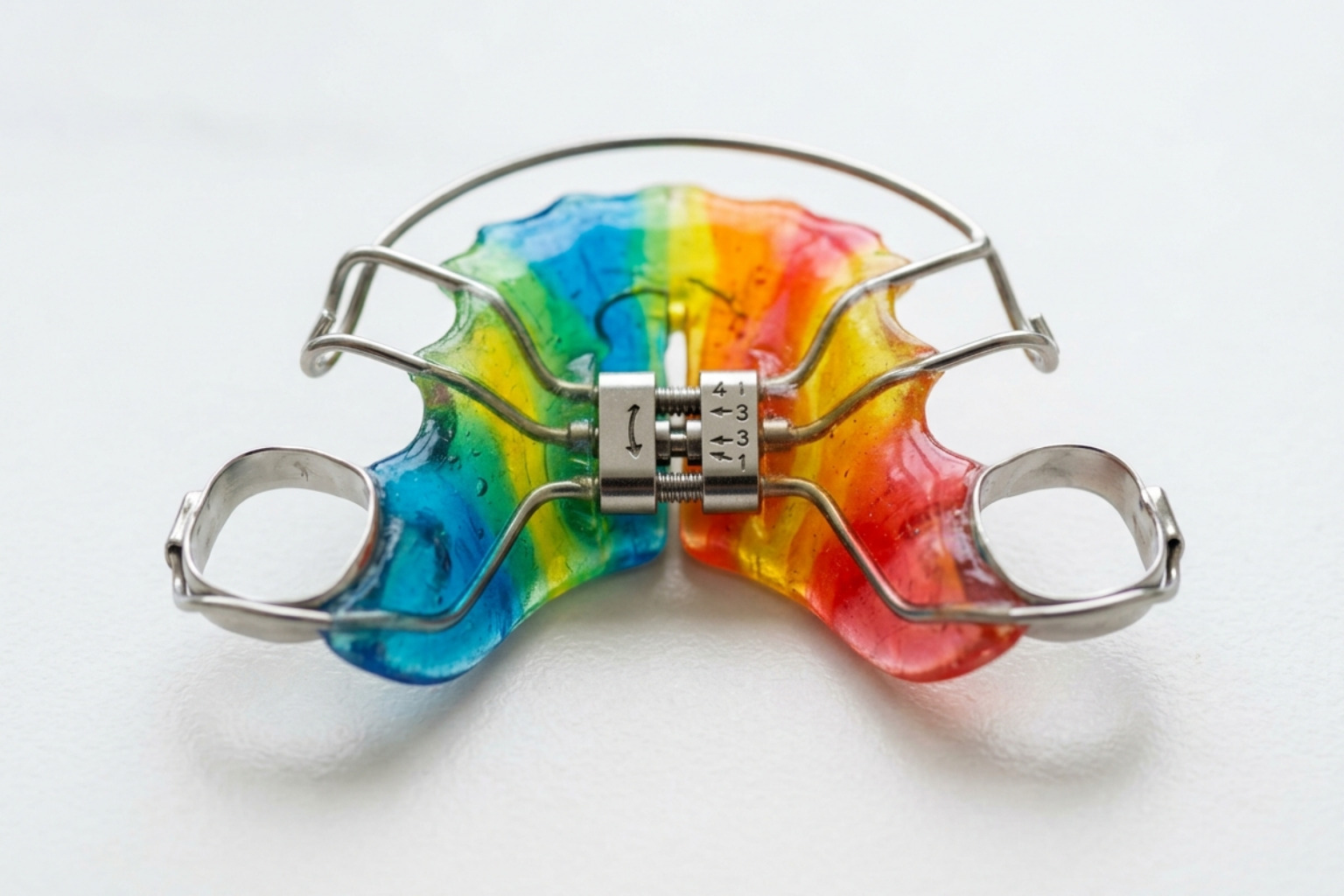
We use a variety of specialised appliances to guide growth during Phase 1. These are often much simpler than a full set of braces. A “palatal expander” is one of the most common tools; it gently widens a narrow upper jaw to correct a crossbite and create space for crowded teeth. Research shows that roughly 80% of unilateral posterior crossbites in the mixed dentition are due to functional shifts that an expander can resolve.
Other appliances include space maintainers, which hold a gap open if a baby tooth is lost too early, and functional appliances that help the upper and lower jaws align correctly. For families looking for a more discreet option, we also offer Invisalign First, which uses clear aligners specifically designed for growing mouths. These aligners are excellent for widening arches and managing space while being removable for easy cleaning.
Ensuring patient compliance
The success of Phase 1 depends heavily on the child following instructions, whether that is wearing an aligner or keeping an expansion appliance clean. Dr Nick and our team in Brisbane pride ourselves on building strong relationships with our younger patients. We make the process fun and engaging, using colourful appliances and positive reinforcement.
Parental support is also vital. We provide clear hygiene instructions and regular check-ins to ensure everything is on track. Because Dr Nick sees every patient personally, he can closely monitor compliance and adjust the treatment plan as needed. You can learn more about Dr Nick and his 30 years of experience in managing these delicate early cases.
Frequently Asked Questions
Is early orthodontic intervention always necessary?
No, early treatment is only recommended when there is a clear functional or skeletal benefit that cannot be achieved as effectively later. Dr Nick adopts a conservative approach, often placing children in an observation programme to monitor growth until the optimal time for treatment arrives. We only suggest active Phase 1 care if it will significantly reduce the complexity of future treatment or prevent a more serious issue like impacted teeth or jaw surgery.
How long does a child need to wear a retainer after Phase 1?
Children typically wear a retainer during the resting period between Phase 1 and Phase 2 to maintain the corrections made to the jaw and tooth positions. This period lasts until most of the permanent teeth have erupted, which usually occurs around age 12 or 13. During this time, Dr Nick will see your child for quick check-ups every 6 to 12 months to ensure the adult teeth are coming in as expected.
Can clear aligners be used for early intervention?
Yes, specialised clear aligner systems like Invisalign First or Spark aligners are designed specifically for children in the mixed dentition stage. These aligners can address issues like arch expansion and crowding while allowing the child to maintain excellent oral hygiene. Because they are removable, they are often a preferred choice for children who play contact sports or musical instruments.
Your Next Step with Dr Nick
Brisbane families choose NK Orthodontist because Dr Nick provides personal continuity of care, seeing every child at every appointment for over 30 years. With locations in Chermside and Spring Hill, we offer a transparent approach to early care with all-inclusive pricing and no hidden fees. You do not need a referral from a dentist to begin your child’s orthodontic treatment with a specialist.
If you have noticed your child struggling with chewing, mouth breathing, or if you simply want the peace of mind that their dental development is on the right track, we are here to help. You can view our smile gallery to see the types of cases we manage or Book Now for your initial consultation.


