Blogs

Blogs

How Many Appointments Before Getting Braces? Your Step-by-Step Timeline 150 150 Aileen Strive

How Many Appointments Before Getting Braces? Your Step-by-Step Timeline

What to Expect Before Braces Go On: Your Appointment Timeline Explained

how many appointments before getting braces

Wondering how many appointments you need before getting braces? For most patients, it takes an initial consultation, diagnostic records, and then a bonding appointment, although some simple cases can move faster.

Key Takeaways

  • Most patients need a consultation, diagnostic records, and a braces fitting appointment before treatment begins.
  • Your timeline depends on your teeth, gums, bite, and whether any dental work is needed first.
  • Children may need growth monitoring before they are ready for full braces.
  • Adults can often move directly into treatment once their gum health and dental work are checked.
  • Booking an orthodontic consultation early helps you understand your options, costs, and likely timeline.

Key Takeaways

  • A thorough clinical assessment is essential to ensure teeth and gums are in optimal condition before orthodontic treatment begins.
  • Maintaining routine general dental checkups can help streamline the preparation process and avoid unexpected delays.
  • Specialist orthodontists customise the preparation timeline based on individual clinical needs and jaw development.
  • Understanding the financial aspects early by reviewing the pricing page helps families plan their treatment with confidence.
  • Digital modeling for clinical planning allows for precise preparation before any physical appliances are fitted.

About the Author

I am Dr Nick, a Specialist Orthodontist based in Brisbane with decades of experience and thousands of patients treated across my Chermside practice. Having guided patients through how many appointments before getting braces countless times, I want to give you the clearest possible picture of what lies ahead so you can walk into your first visit with confidence.

How Many Appointments Before Getting Braces?

If you are planning braces, you probably want to know how many visits you will need before anything is fitted. In most cases, you will have a few appointments before braces go on. These visits are not there to slow things down. They help make sure your teeth, gums, and jaw are healthy enough for orthodontic treatment.

Think of it like building a house. You would not put the roof on before checking the foundations. In the same way, we need to make sure there is no active decay, gum inflammation, or other dental issue before we start moving teeth.

For a straightforward case, your consultation and records may be close together, or sometimes combined depending on your needs. If you need a clean, filling, extraction, or gum treatment first, the process can take longer.

Preparation Level Typical Visits What It Usually Means
Straightforward case Minimal visits Good oral hygiene, no active decay, recent clean, and simple alignment needs.
Average case A few visits A routine clean, small filling, or separate records appointment may be needed.
More complex case Multiple visits Severe crowding, planned extractions, gum issues, or several dental treatments may need to be managed first.

Keeping up with your regular general dental check-ups can make the process smoother and help you move into braces with fewer delays.

The Step-by-Step Pre-Braces Appointment Timeline

Here is what usually happens before braces are placed. Your exact pathway may look a little different, but these are the main stages most patients go through.

Step 1: Your Initial Orthodontic Consultation

Your first step is an in-person consultation with a specialist orthodontist. This visit is all about understanding your goals, checking your bite, and working out whether braces are the right option for you.

I will look closely at your teeth, bite, jaw relationship, and facial profile. We will also talk through your treatment options, which may include braces or clear aligners such as Spark and Invisalign.

At NK Orthodontist, your care is not delegated. I personally see every patient at every appointment, so you receive consistent specialist care from the very beginning.

Step 2: Diagnostic Records and Treatment Planning

Once we know the general direction of your treatment, we take detailed diagnostic records. This gives us the information needed to plan your tooth movement safely and accurately.

During this appointment, we may take:

  • Digital 3D scans to create accurate models of your teeth without messy traditional impressions.
  • Orthodontic X-rays to assess your tooth roots, jaw bone, and facial structure.
  • Clinical photographs to document your starting point and support treatment planning.

We use this information to plan how each tooth should move before the braces are fitted.

Step 3: The Braces Fitting Appointment

The day your braces are placed is the exciting part. The fitting process is usually straightforward, although your mouth will be open for a while and your teeth may feel tender afterwards.

Here is what usually happens:

  • Your teeth are cleaned and dried so the adhesive can bond properly.
  • Each bracket is carefully positioned on your teeth.
  • A curing light is used to set the adhesive.
  • The first archwire is placed and secured with small elastic bands.
  • We show you how to brush, floss, eat, and care for your braces at home.

Before this appointment, it helps to have a filling meal and apply lip balm so you are more comfortable during the fitting.

What Can Add Extra Visits Before Braces?

We always aim to keep your preparation as simple as possible, but sometimes extra appointments are needed before it is safe to start braces. Your teeth and gums need to be healthy first.

The most common reasons for additional visits include:

  • Active tooth decay that needs to be treated by your general dentist.
  • Gum inflammation or periodontal concerns that need to settle before treatment begins.
  • Planned tooth extractions in cases of severe crowding.
  • A professional clean if plaque or tartar needs to be removed before brackets are fitted.

You can also review our pricing information early so you know what to expect financially before starting treatment.

How Many Appointments Before Getting Braces for Children?

For children, the timeline can look a little different. Many children do not need braces straight away at their first visit. Instead, we may monitor their jaw growth, bite, and adult tooth eruption until the timing is right.

If we notice a developing issue, such as a crossbite or significant jaw imbalance, we may recommend early interceptive treatment. This can help guide growth and make later treatment more straightforward.

That means children may have several review visits over months or even years before they are ready for full braces. These visits are not wasted time. They help us choose the right moment to begin.

How Many Appointments Before Getting Braces for Adults?

Adults usually follow a more direct path because jaw growth is already complete. However, adult treatment still needs careful checking before braces are fitted.

We look closely at gum health, existing dental work, crowns, bridges, fillings, and any signs of wear. If your gums are healthy and no dental work is needed first, you may move through the preparation stage quite efficiently.

Some adults may need extra visits with their general dentist or periodontist before starting. Once everything is stable, braces can be planned and fitted with confidence.

Ready to Plan Your Braces Timeline?

At NK Orthodontist, we want you to feel clear and confident before treatment begins. From your first consultation, we will explain what needs to happen, how many appointments you are likely to need, and whether anything should be completed with your general dentist first.

When you choose NK Orthodontist, your treatment is never delegated to assistants or hygienists. I personally see every patient at every appointment, so you always know who is guiding your care. We also offer transparent fees, flexible interest-free payment plans, and a welcoming Brisbane practice environment.

If you are ready to find out what your own braces timeline looks like, you can book an orthodontic consultation online and take the first step towards a healthier, straighter smile.

Frequently Asked Questions

How long does the process take from the first consultation to getting braces?

The timeline from your initial consultation to having braces fitted usually takes a few weeks. This gives your orthodontist time to assess your teeth, take diagnostic records, plan treatment, and arrange any dental preparation if needed. Your exact timing depends on your oral health, treatment needs, and appointment availability.

Can I get braces put on during my very first appointment?

Usually, no. Your first appointment is normally used for a proper assessment, discussion of treatment options, and planning. Braces should not be placed without the right diagnostic records and treatment plan because this can compromise the outcome.

What happens if I skip my regular dental cleans before getting braces?

Skipping professional cleans can allow plaque and tartar to build up before brackets are fitted. This increases the risk of tooth decay, gum inflammation, and white marks on the teeth during orthodontic treatment. Having your teeth clean and healthy before braces gives you a much better starting point.

Do children need more preparatory appointments than adults?

Children may need more monitoring appointments because their jaws and adult teeth are still developing. They might not need braces straight away, even if an orthodontic issue is present. Adults usually move more directly into treatment once their teeth and gums have been checked.

How should I prepare for my braces fitting appointment?

Brush and floss carefully before your visit, eat a satisfying meal, and apply lip balm beforehand. It is also helpful to have soft foods ready at home for the first few days while your teeth adjust.

Will putting braces on hurt?

Having braces fitted is not usually painful, but you may feel pressure, stretching, or mild jaw fatigue during the appointment. Tenderness is common for a few days afterwards as your teeth begin adjusting. This usually settles with soft foods and sensible care.

Can I reduce the number of appointments needed before getting braces?

You can help by keeping up with general dental check-ups, treating any cavities or gum issues early, and maintaining good oral hygiene. Being organised with appointments and records can also help prevent delays.

Invisalign specialist Brisbane certified
Finding a Certified Invisalign Specialist in Brisbane 1080 720 Aileen Strive

Finding a Certified Invisalign Specialist in Brisbane

Why Choosing a Specialist Orthodontist for Invisalign in Brisbane Matters

If you are looking for Invisalign treatment in Brisbane, it helps to know what separates specialist orthodontic care from a general clear aligner provider.

Key Takeaways

  • Check that your practitioner is registered with AHPRA as a Specialist Orthodontist, not only as a general dentist.
  • Look for verified Invisalign experience, ideally with a higher provider designation such as Platinum Elite.
  • Ask whether your treatment will be planned with digital scanning, clinical modelling, and specialist oversight.
  • Make sure pricing, treatment options, and expected timelines are explained clearly before you commit.
  • Choose a practice where you know who will see you at each appointment and who is responsible for your care.

Clear aligners are a popular orthodontic option in Australia, and Invisalign is one of the best-known systems available. Because many dental practices now offer aligner treatment, it is worth understanding the difference between an Invisalign provider and a registered Specialist Orthodontist.

Not every practitioner who offers Invisalign has the same level of orthodontic training, experience, or specialist registration. That difference can matter, especially if your treatment involves crowding, bite concerns, spacing, or anything more complex than minor tooth movement.

I’m Dr Nick, a Specialist Orthodontist based in Brisbane with over 30 years of experience and more than 22 years working with the Invisalign system. As a Platinum Elite Invisalign provider and the founder of NK Orthodontist, I’ve guided more than 11,500 patients through specialist orthodontic care at our Chermside practice. In this guide, I’ll explain what to look for in Specialist Orthodontist-led Invisalign treatment in Brisbane before you begin.

Choosing a Specialist Orthodontist for Invisalign in Brisbane

When you start comparing clear aligner options, you will notice that many different dental professionals offer Invisalign and similar systems. The important question is who is planning and supervising your treatment.

A general dentist looks after general dental health, including check-ups, fillings, hygiene, and everyday dental care. Some dentists complete short courses to offer clear aligners, but their core training is not focused solely on orthodontic tooth movement.

A Specialist Orthodontist completes dental training first, then undertakes additional full-time postgraduate study in orthodontics. This specialist training focuses on tooth movement, facial growth, bite correction, jaw alignment, and the biology behind sound, evidence-based orthodontic treatment.

To verify whether your chosen practitioner is a registered specialist, search the AHPRA register of practitioners. Their registration details should list the specialty as “Orthodontist”. If the practitioner is listed only as a dentist, they do not hold specialist orthodontic registration in Australia.

Choosing a Specialist Orthodontist for Invisalign in Brisbane means your treatment is planned by someone who understands both the technology and the clinical biology behind tooth movement. That matters because aligner software is only a tool. The quality of the result still depends on the clinician designing and monitoring the treatment.

How Specialist Clear Aligner Treatment Works

Clear aligner treatment relies on accurate records, careful planning, and custom-made aligners. Instead of traditional putty impressions, modern specialist practices often use high-resolution intraoral scanners to create a precise three-dimensional model of your teeth.

I use this digital model to plan the sequence of tooth movements. This is where specialist experience becomes especially important. The software can show a proposed outcome, but the clinical plan needs to be realistic, stable, and safe for your teeth, gums, and bite.

Once the plan is finalised, a series of custom aligners is made. Each aligner applies controlled orthodontic force to selected teeth, gradually guiding them towards their planned positions.

To make the process easier to understand, here is how specialist clear aligner treatment usually unfolds:

Stage Clinical Focus What You Do
Initial assessment Clinical examination, photography, and digital scanning Attend the consultation and discuss your goals
Clinical planning Digital modelling of planned tooth movements Review the proposed plan and ask questions
Aligner fabrication Custom aligners made from the approved plan Collect your aligners and learn how to wear them
Active treatment Regular monitoring and aligner progression Wear your aligners for the recommended daily hours
Retention phase Stabilising your teeth in their new positions Wear your retainers as directed

What to Expect at Your Consultation

Your consultation is where we work out whether Invisalign or another clear aligner system is right for you. At NK Orthodontist, we begin with a clinical assessment, photos, and a high-resolution digital scan of your teeth.

I will personally examine your teeth, jaws, and facial profile. We will talk about what you would like to improve, what is clinically possible, and whether clear aligners are the best option for your case. I also explain your options in plain language, so you can make a confident decision without feeling rushed.

Your consultation includes a discussion of likely costs, timelines, treatment options, and next steps. You can also learn more about my background and clinical approach on the Dr Nick profile page.

Can Invisalign Treat More Complex Cases?

Some people assume clear aligners are only for mild cosmetic changes. In the right hands, they can often be used for more involved orthodontic concerns too.

These may include:

  • Crowding, where there is not enough space in the dental arch.
  • Deep bites or overbites, where the upper teeth overlap the lower teeth too much.
  • Spacing or gaps between teeth.
  • Mild to moderate jaw or bite discrepancies.

More complex cases need careful planning and a strong understanding of biomechanics. Sometimes we use small, tooth-coloured attachments on the teeth to help the aligners grip and move teeth more predictably.

We also offer Spark aligners alongside Invisalign. During your assessment, we will talk through which system best suits your teeth, bite, goals, and lifestyle.

Treatment Timelines, Costs, and Day-to-Day Care

Clear aligner treatment time depends on the complexity of your case. Minor alignment may be completed more quickly, while comprehensive orthodontic treatment usually takes longer and needs a more detailed plan. At your consultation, I will give you a personalised estimate based on your teeth, bite, and goals.

We keep pricing clear because it is easier to make a decision when you know what is included. At our practice, we offer:

  • Comprehensive initial consultations for $90.
  • Minor alignment treatments starting from $3,500.
  • Comprehensive clear aligner treatments ranging from $7,000 to $9,500.

These fees include your diagnostic records, active aligners, clinical monitoring appointments, and final retainers. We also offer flexible, interest-free payment plans to help make treatment more manageable.

If you have private health insurance with orthodontic cover, you may be eligible for a rebate on your treatment. Your level of cover and annual limits depend on your individual policy, so it is best to check directly with your health fund before you begin.

Day-to-day care is also important. You will need to wear your aligners as directed, keep them clean, and store them safely when they are not in your mouth. For practical instructions, read our guide to caring for your clear aligners.

Ready to Talk About Specialist Invisalign Care in Brisbane?

Choosing clear aligner treatment is a personal decision, and the right guidance can make the process feel much simpler. At NK Orthodontist, we have been helping Brisbane families achieve healthy, aligned smiles since 1995.

We operate from our Chermside practice at 510 Rode Road.

When you choose NK Orthodontist, you benefit from:

  • Over 30 years of specialist orthodontic experience.
  • Personal care from Dr Nick at every appointment.
  • Clear, comprehensive pricing with flexible, interest-free payment options.
  • A welcoming Brisbane practice with more than 565 five-star Google reviews.

If you are ready to explore Invisalign treatment with a Specialist Orthodontist in Brisbane, you can book now for your clinical assessment.

Frequently Asked Questions

How do I verify if a practitioner is a certified specialist in Brisbane?

You can verify a practitioner’s credentials by searching the online register of the Australian Health Practitioner Regulation Agency, known as AHPRA. A registered Specialist Orthodontist should have “Orthodontist” listed under their specialty registration details. If someone is listed only as a dentist, they do not hold specialist orthodontic registration.

Why choose a Specialist Orthodontist for clear aligner treatment?

A Specialist Orthodontist has advanced orthodontic training focused on tooth movement, bite correction, jaw alignment, and treatment planning. This helps with precise clear aligner planning, especially when treatment involves more than minor cosmetic movement.

Can clear aligners manage complex orthodontic issues?

Yes, clear aligners can manage many complex orthodontic concerns, including crowding, deep bites, and spacing. The key is careful diagnosis, planning, and monitoring by a clinician with the right orthodontic training and experience.

How long does clear aligner treatment typically take?

Treatment time depends on the amount and complexity of tooth movement needed. Some minor cases are quicker, while comprehensive treatment usually takes longer. Wearing your aligners for the recommended daily hours is one of the most important ways to keep treatment on track.

What are the potential risks or side effects of clear aligners?

Some people feel mild pressure or tenderness when changing to a new set of aligners. Temporary speech changes, such as a slight lisp, can also occur at first. These effects are usually short-lived, and your orthodontist will monitor your teeth and gums during treatment.

Does private health insurance cover clear aligner treatment in Australia?

Many Australian private health insurance policies with orthodontic cover provide rebates for clear aligner treatment. Your rebate depends on your policy, waiting periods, annual limits, and lifetime orthodontic limits, so check with your health fund before starting.

What aftercare is required to maintain results after clear aligner treatment?

After active treatment, retainers help stop your teeth from shifting back towards their old positions. We provide clear plastic retainers and explain how often to wear them. Retainer wear usually changes over time, often moving from more frequent wear to night-time wear.

Spark aligners extraction free Brisbane
Keep Your Teeth and Get Them Straight with Spark Aligners in Brisbane 1080 720 Aileen Strive

Keep Your Teeth and Get Them Straight with Spark Aligners in Brisbane

If you want straighter teeth but feel nervous about being told you need teeth removed first, Spark aligners may give you another option. At NK Orthodontist in Brisbane, Dr Nick focuses on preserving healthy teeth wherever clinically possible while still planning for a stable, confident smile.

Key Takeaways

  • Spark aligners can help straighten teeth using clear, removable trays custom-planned for your smile.
  • Extraction-free treatment means healthy teeth are kept in place wherever it is safe and clinically appropriate.
  • Suitability depends on your crowding, bite, jawbone, gum health, and overall orthodontic goals.
  • Dr Nick personally sees every patient at every appointment at NK Orthodontist in Brisbane.
  • You can start with a consultation or the online assessment form to see what may be possible for your smile.

Brisbane patients often ask whether they can get clear aligners without having healthy teeth taken out. The answer is that many people can, but it always depends on a proper clinical assessment.

I’m Dr Nick, a Specialist Orthodontist with over 30 years of experience and founder of NK Orthodontist. My approach to extraction-free Spark aligners in Brisbane is simple: keep your natural teeth wherever we safely can, explain your options clearly, and create a treatment plan that suits your mouth rather than forcing your mouth to suit a generic plan.

Key Takeaways

  • Spark aligners may help you achieve a straighter smile without the need for tooth extractions.
  • An extraction-free approach preserves your natural dental arch and can support overall oral health.
  • A clinical assessment with a specialist orthodontist is required to determine your suitability for this treatment.
  • Flexible payment options are available to help manage the cost of your care, which you can explore on our pricing page.
  • You can learn more about the benefits of custom aligners by reading our Ultimate Checklist for Clear Teeth Straighteners.

Understanding Extraction-Free Spark Aligner Options in Brisbane

To understand how teeth can be straightened without removing them, it helps to look at how orthodontic planning has changed. In the past, some crowded smiles were treated by removing premolars to create extra room. Today, advanced clear aligner systems allow us to take a more conservative approach for many Brisbane patients.

Spark aligners are made from a medical-grade polyurethane material known as TruGEN. The material is designed to look clear, resist staining, and deliver controlled force as each aligner guides your teeth into position. Because every set is custom-designed for your teeth, we can plan each movement carefully before treatment begins.

In an extraction-free treatment plan, the goal is to work with your natural dental arch rather than remove healthy teeth for space. Depending on your mouth, we may create room through careful arch development or minor tooth slenderising. This can be a good option for patients who want to avoid the discomfort, recovery, and permanence of dental extractions where there is a safe alternative. For a broader look at clear aligner choices, you can read the complete guide to invisible braces.

When the natural dental arch can be preserved, the result can look balanced and natural. The aim is not just to line up the front teeth, but to support your bite, smile shape, and facial profile in a way that feels right for you.

Are You Suitable for Extraction-Free Clear Aligners?

Extraction-free treatment sounds appealing, but it is not the right answer for every person. Orthodontic care needs to be planned around your teeth, gums, jawbone, bite, and long-term stability.

During your assessment, we look at the quality of your jawbone, the health of your gums, and the amount of crowding or spacing present. We also use digital modelling for clinical planning, which helps us see how your teeth may move within your existing bone structure. That planning matters because we want your smile to look good and stay healthy. For general information about orthodontic care in Australia, you can visit Healthdirect Australia’s orthodontic treatment guide.

Signs Extraction-Free Spark Aligners May Suit You

Many patients who visit our Chermside practice are good candidates for extraction-free care. Common signs include:

  • Mild to moderate crowding: If teeth are only slightly overlapped, we may be able to create space by gradually widening the dental arch or gently polishing between teeth.
  • Dental spacing or gaps: If there are gaps between your teeth, extractions are usually not needed because the goal is to bring the teeth closer together.
  • Narrow dental arches: In some cases, gently widening the arch can improve tooth alignment and support the cheeks and lips.

If these points sound familiar, Spark aligners may be worth exploring at your consultation.

When Extractions Might Still Be Considered

My priority is always to preserve healthy teeth whenever possible. Still, there are times when extractions may be the safest or most stable option.

For example, severe crowding may mean there is not enough jawbone to support every tooth in a healthy position. Significant jaw discrepancies or teeth that sit too far forward may also require extractions so the bite, lips, and smile can be brought into better balance. If that applies to you, I will explain why, show you the reasoning, and talk through your options before any decision is made.

What to Expect During Spark Aligner Treatment in Brisbane

Starting orthodontic treatment should feel clear, not confusing. At NK Orthodontist, the process begins with a detailed assessment and a conversation about what you want to change.

Your first visit includes a clinical consultation where I examine your teeth, jaws, and facial profile. If extraction-free Spark aligner treatment looks suitable, we take digital impressions of your teeth with an intraoral scanner, so there is no need for messy traditional moulds.

From there, I design your treatment plan step by step. Digital modelling lets us map the movement of each tooth before your aligners are made. Once your custom aligners arrive at our Brisbane practice, we fit them and show you exactly how to wear and care for them.

Throughout treatment, you will wear each set of aligners for the prescribed period, removing them to eat, drink, brush, and floss. You will also return to the practice regularly so I can personally monitor your progress and make sure your teeth are moving as planned.

How Spark Aligners Compare with Other Clear Aligners

Many patients ask how Spark compares with other clear aligner options. Several systems can work well, but Spark aligners have features that make them appealing for both patients and clinicians.

The TruGEN material used in Spark aligners is designed to be very clear, which makes the trays discreet. The edges are scalloped and polished to fit snugly and help minimise gum irritation, although mild pressure or tenderness can still happen when you start a new set. Spark aligners are also designed to resist everyday staining better than some alternative materials.

Feature Spark aligners Other clear aligners
Material clarity High transparency with TruGEN material Standard clear plastic
Stain resistance Designed to resist daily staining May discolour over time
Edge finish Scalloped and polished to help minimise irritation Comfort may vary by brand
Clinical control Detailed digital planning tools Digital setup varies by system

The best aligner system for you depends on your clinical needs, goals, and the way your teeth need to move.

Cost and Payment Plans for Clear Aligners in Brisbane

The cost of orthodontic treatment matters, and you should know what to expect before you start. At NK Orthodontist, we aim to keep pricing clear and easy to understand.

Your treatment quote includes your initial diagnostic records, active aligners, clinical appointments with Dr Nick, and your final in-house clear plastic retainers or fixed wire retainers. We can also help you claim any eligible private health insurance benefits, and flexible interest-free payment plans are available to spread the cost over time. You can view the current details on our pricing page.

What Spark Aligners May Cost

Fees depend on the complexity and length of your treatment:

  • Initial consultations: Comprehensive clinical consultations are $90.
  • Minor alignment: Simpler cases that need minimal movement start from $3,500.
  • Comprehensive treatment: More complex cases involving comprehensive movement and arch development usually range from $7,000 to $9,500.

These fees are designed to be comprehensive, so there are no surprises later. If you would like a first step before booking in person, the online assessment form can help you get started from home.

Frequently Asked Questions

What are Spark aligners, and how are they different from braces?

Spark aligners are clear, removable trays that gradually move your teeth. Unlike braces, they do not use metal brackets or wires, and you can remove them for eating, brushing, and flossing.

What does extraction-free orthodontic treatment mean?

Extraction-free treatment means straightening your teeth without removing healthy teeth to create space. Instead, the plan may use careful arch development or minor tooth slenderising where appropriate.

How long does Spark aligner treatment usually take?

Treatment time depends on your teeth, bite, and the amount of movement needed. Minor cases may be quicker, while more comprehensive cases take longer. You will receive a tailored estimate at your consultation.

Are there risks or side effects with clear aligners?

You may feel mild pressure, tenderness, or tooth sensitivity when you start a new set of aligners. This is common and usually settles within a few days. Good brushing and flossing are also important so plaque does not build up under the trays.

How do I care for Spark aligners?

Clean your aligners daily with a soft toothbrush and lukewarm water. Brush and floss before putting them back in, and avoid hot water because it can warp the plastic. Our guide on caring for your clear aligners explains this in more detail.

Can teenagers use Spark aligners for extraction-free treatment?

Yes, clear aligners can suit some teenagers once the permanent teeth have erupted. Suitability depends on the teen’s teeth, bite, maturity, and ability to wear the aligners as directed.

How do I find a qualified Spark aligner provider in Brisbane?

Look for a registered specialist orthodontist with experience in clear aligner treatment. A specialist orthodontist has completed additional university training beyond a general dental degree, which helps with diagnosis, treatment planning, and long-term stability.

Ready to See if Extraction-Free Spark Aligners Are Right for You?

When you choose NK Orthodontist, you are choosing a Brisbane practice with over 30 years of specialist orthodontic experience. Dr Nick personally sees every patient at every appointment, so your care is never delegated to a hygienist or dental assistant.

We operate from modern, welcoming practices in Chermside and Spring Hill, giving Brisbane patients convenient access to specialist orthodontic care.

If you are hoping to straighten your teeth while keeping healthy teeth in place, we would be happy to help you understand your options. Book a consultation with Dr Nick and find out whether extraction-free Spark aligners are suitable for your smile.

dental specialist orthodontist
Dentist vs Dental Specialist Orthodontist: What’s the Real Difference? 940 627 Aileen Strive

Dentist vs Dental Specialist Orthodontist: What’s the Real Difference?

What It Really Means to See a Dental Specialist Orthodontist

If you have been told you need braces, clear aligners, or help with your bite, it can be confusing to know whether to see a general dentist or a dental specialist orthodontist. The short answer is this: all specialist orthodontists are qualified dentists, but not all dentists are specialist orthodontists.

Key Takeaways

  • A specialist orthodontist completes additional full-time university training after becoming a dentist, with a focus on teeth, bite, and jaw alignment.
  • In Australia, only practitioners with AHPRA specialist registration can use the title “Specialist Orthodontist”.
  • A general dentist looks after broad oral health, while an orthodontist focuses exclusively on orthodontic diagnosis, planning, and treatment.
  • You do not need a referral to book an orthodontic consultation, including for children, teens, or adults.
  • Seeing a specialist can be especially helpful if your case involves crowding, spacing, bite concerns, jaw growth, or more complex treatment planning.

About Dr Nick

I am Dr Nick, a Specialist Orthodontist based in Brisbane with more than 30 years of experience in specialist orthodontic practice and over 11,500 patients treated at my Chermside practice. I work exclusively in orthodontics, so my role is to help you understand what the title means, why it matters, and how to make a confident decision about your care.

What Is a Dental Specialist Orthodontist?

A dental specialist orthodontist is a registered dental specialist who focuses on the alignment of teeth, jaw relationships, bite issues, and facial development. In Australia, specialist registration is governed by the Dental Board of Australia and the Australian Health Practitioner Regulation Agency, commonly known as AHPRA.

A simple way to think about it is this: your general dentist is the person you see for everyday oral health, such as check-ups, fillings, gum care, and general dental concerns. A specialist orthodontist is the person you see when your teeth, bite, or jaws need a more detailed orthodontic assessment.

Educational Pathway of a Dental Specialist Orthodontist

The path to becoming a registered specialist in Australia is demanding and highly competitive. It involves years of university-based education and clinical training.

  1. General dental degree: A specialist orthodontist must first complete a university dental degree, which qualifies them as a general dentist.
  2. Clinical experience: Dentists commonly spend time working in general practice before applying for specialist training. This gives them a strong understanding of general oral health and patient care.
  3. Postgraduate orthodontic training: They must then complete an accredited full-time university postgraduate programme focused solely on orthodontics.

During specialist training, the focus is not on general dental procedures like fillings, crowns, or extractions. It is on tooth movement, facial growth, biomechanics, bite correction, and complex orthodontic treatment planning.

Specialist Registration and Professional Standards

After completing postgraduate orthodontic training, an orthodontist must be registered with AHPRA as a specialist before they can use the title “Specialist Orthodontist” in Australia.

This matters because the title is not just a marketing phrase. It reflects formal training, specialist registration, and a practice focus limited to orthodontic care. For patients, that can make a real difference when treatment decisions involve growth, bite correction, aligner planning, braces, or long-term stability.

General Dentist vs Orthodontist: What Is the Difference?

It is completely understandable if the distinction feels unclear at first. Both dentists and orthodontists work with teeth, both are qualified dental professionals, and both can be involved in your oral health. The difference is in their training, focus, and day-to-day scope of work.

A general dentist is your primary oral health provider. They look after routine examinations, cleans, fillings, crowns, gum health, and other general dental needs.

An orthodontist, by contrast, limits their practice to orthodontic care. At NK Orthodontist, we work alongside your general dentist, who continues to manage your routine oral health while we focus on your teeth, bite, and jaw alignment. You can learn more about that approach in our guide to comprehensive orthodontic care.

Scope of Practice

General dentists in Australia are allowed to provide some orthodontic treatments, including braces or clear aligners. However, their training is broad, while an orthodontist’s training is specialised in orthodontics.

That distinction becomes important when a case is more complex. Crowding, bite discrepancies, jaw growth patterns, impacted teeth, and long-term stability all require careful diagnosis and planning. A specialist orthodontist manages these types of concerns every day.

Treatment Options and Technology

Modern orthodontic treatment is not one-size-fits-all. At NK Orthodontist, treatment options may include:

  • Metal braces: A reliable option for many orthodontic cases.
  • Clear ceramic braces: A more discreet bracket option that blends more naturally with the teeth.
  • Spark clear aligners: A clear aligner system designed for people who want a removable and less noticeable option.
  • Invisalign: A well-known clear aligner option for suitable cases.
  • Digital scanning and planning: 3D scanning helps us create detailed digital models of your teeth and plan treatment with greater precision.

If you want a broader overview of modern options, read our guide to modern orthodontic treatments.

When Should You See a Dental Specialist Orthodontist?

Orthodontic treatment is about more than straight teeth. It looks at how your teeth meet, how your jaws relate to each other, and how your smile can function comfortably over the long term.

Common reasons to book an orthodontic assessment include:

  • Crowding: There is not enough space for the teeth to sit naturally.
  • Spacing: There are gaps or wide spaces between the teeth.
  • Overbite: The upper front teeth overlap the lower front teeth more than expected.
  • Underbite: The lower front teeth sit ahead of the upper front teeth.
  • Crossbite: Some upper teeth sit inside the lower teeth when biting together.
  • Jaw growth concerns: The upper and lower jaws may not be developing in balance.

You do not need a formal referral from a general dentist to book an appointment with a specialist orthodontist in Australia. If you have noticed changes in your bite, spacing, crowding, or jaw alignment, you can contact our practice directly to arrange an in-person consultation.

Orthodontic Checks for Children

Children are often best assessed while their jaws are still developing. An early orthodontic visit around age seven to eight can help identify whether growth guidance may be useful or whether it is better to simply monitor development for now.

Most children do not need immediate treatment at this age. The benefit of an early check is timing. If treatment is needed later, we can plan it at the stage when it is likely to be most effective. You can learn more about this on our kids orthodontic care page.

Orthodontic Treatment for Adults

Adults can also benefit from orthodontic care. Even though jaw growth has finished, teeth can still be guided into better alignment when the gums and supporting structures are healthy.

Many adult patients prefer discreet options such as clear aligners because they fit more easily into work, social events, and everyday life. During your assessment, we look at your teeth, gums, bite, and treatment goals before recommending the most suitable option.

Frequently Asked Questions

What is the main difference between a dentist and an orthodontist?

The main difference is specialist training. A general dentist completes a dental degree and provides broad oral health care. A specialist orthodontist first qualifies as a dentist, then completes additional postgraduate orthodontic training and focuses only on teeth, bite, and jaw alignment.

Do I need a referral from a dentist to see an orthodontist?

No. In Australia, you can book directly with a specialist orthodontist. Many patients are referred by their dentist, but a referral is not required.

Can a general dentist provide braces or clear aligners?

Yes, general dentists can provide some orthodontic treatments. However, they are not specialist orthodontists unless they have completed the required postgraduate orthodontic training and hold specialist registration with AHPRA.

When should a child first see an orthodontist?

A child can have an early orthodontic check at around seven to eight years of age. This does not mean treatment will start straight away. It simply allows the orthodontist to assess jaw growth, tooth eruption, and bite development.

Does private health insurance cover orthodontic treatment in Australia?

Some Australian private health insurance extras policies include orthodontic benefits, but coverage varies. It is best to check directly with your health fund. We can provide treatment details and item codes to help you understand your entitlements.

What happens during the first orthodontic consultation?

Your first visit includes an assessment of your teeth, bite, and jaw relationships. We discuss what we can see, explain whether treatment is recommended, and outline suitable options, timing, and costs.

How long does orthodontic treatment usually take?

Treatment time depends on the complexity of the case, the type of appliance used, and how your teeth respond. Minor movement may be quicker, while comprehensive treatment usually takes longer. We provide a personalised estimate after your assessment.

Choosing the Right Orthodontic Care in Brisbane

Choosing who plans your orthodontic care is an important decision. At NK Orthodontist, our approach is personal, clear, and specialist-led from start to finish.

When you visit our Chermside practice, you will see me at every appointment. I personally plan and manage your care, so your treatment is never delegated. With more than 30 years of specialist experience and over 11,500 patients treated, our goal is to make the process feel informed, comfortable, and transparent.

We also provide clear pricing, no hidden fees, and interest-free payment plans to make specialist care easier to access. When you are ready to explore your options, you can book a consultation with us today.

orthodontist Brisbane no extraction
How to Get a Straighter Smile Without Pulling Any Teeth 940 627 Aileen Strive

How to Get a Straighter Smile Without Pulling Any Teeth

If you have been searching for an orthodontist in Brisbane who offers no-extraction treatment options, you are probably hoping there is a way to straighten your smile without removing healthy teeth. The good news is that, for many patients, there may be.

Key Takeaways

  • Non-extraction orthodontics aims to align teeth without removing healthy teeth, using options such as arch development, braces and clear aligners.
  • It may suit both children and adults, depending on crowding, jaw structure, bite, gum health and bone support.
  • Early orthodontic checks for children can help guide jaw development and may reduce the chance of extractions later.
  • Digital scans and treatment planning help your orthodontist assess whether a conservative approach is realistic for your smile.
  • A personalised assessment with a Specialist Orthodontist is the only way to confirm whether no-extraction orthodontics is right for you.

Many patients come to our practice after being told they may need teeth removed to make room for orthodontic treatment. That can feel like a big step, especially if those teeth are healthy. It is completely reasonable to ask whether there is another option.

The decision to remove healthy teeth should never be treated as routine. Some smiles can be treated beautifully without extractions, while others need more careful planning. What matters is that your treatment plan is based on your face, jaws, teeth and long-term stability, not a one-size-fits-all rule.

Key Takeaways

  • Non-extraction orthodontics focuses on preserving your natural teeth by expanding the dental arch.
  • Early monitoring from childhood can help guide jaw development and reduce the need for future extractions.
  • Modern clear aligners and digital modelling allow for precise clinical planning without pulling teeth.
  • Patients can explore flexible payment options and transparent fees on our pricing page.
  • A personalised assessment is the first step to determine suitability for a non-extraction approach.

I am Dr Nick, a Specialist Orthodontist based in Brisbane with over 30 years of experience, including a long clinical interest in conservative, non-extraction orthodontic planning for patients across Chermside and wider Brisbane. After working with more than 11,500 patients, I know that many people want to keep their natural teeth if it is clinically safe to do so. I personally oversee every treatment plan, so each patient receives careful, specialist-led care from the first appointment through to the final result.

Understanding No-Extraction Orthodontics in Brisbane

When people search for an orthodontist in Brisbane for no-extraction treatment, they are usually looking for a more conservative approach. In simple terms, they want to know whether their teeth can be aligned without removing healthy premolars to create space.

In some complex cases, extractions are still the most appropriate clinical choice. But modern orthodontics gives us more ways to assess space, guide tooth movement and plan treatment carefully before making that decision.

According to Healthdirect’s guide to orthodontic treatments, orthodontic care is used to improve the alignment and function of the teeth and jaws. For many patients, preserving healthy natural teeth can support that goal when the bite, crowding and facial profile allow it.

What Is the No-Extraction Approach?

The no-extraction approach focuses on creating or using space within the dental arch instead of removing healthy teeth. Depending on the patient, this may involve gentle arch development, carefully planned braces, clear aligners or early intervention for growing children.

Tooth movement works through bone remodelling. With light, controlled pressure, the bone around the teeth adapts as the teeth move into better positions. When this is planned well, many patients can improve crowding and alignment while keeping their natural teeth.

This approach is not about promising that extractions are never needed. It is about asking the right question first: can we achieve a healthy, stable and attractive result while preserving the teeth you already have?

Benefits of a No-Extraction Treatment Plan

When it is suitable, no-extraction orthodontic treatment can offer several benefits:

  • Natural smile support: Keeping healthy teeth can help support the lips and cheeks and contribute to a broader smile.
  • Conservative care: Preserving natural tooth structure is often preferred when it can be done safely and predictably.
  • Facial balance: Treatment can be planned around your natural facial profile rather than simply making space by removing teeth.
  • Comfort with the decision: Many patients feel reassured knowing that extraction was not treated as the automatic first option.

By focusing on arch development, careful alignment and long-term stability, we aim to create a result that suits your face as well as your teeth. If you want to see how orthodontic treatment can change a smile over time, you may find our adult braces before and after guide helpful.

Techniques and Candidates for Non-Extraction Care

Straightening teeth without extractions depends on the right mix of diagnosis, planning and technique. At NK Orthodontist, we look closely at your teeth, jaws, bite, gums and facial profile before recommending a treatment path.

Modern Tools That Can Help Avoid Extractions

Several modern orthodontic tools can help create or manage space within the dental arch. The right option depends on your age, crowding, bite and treatment goals.

Feature Clear Aligners, Including Spark And Invisalign Traditional Braces
Primary mechanism A sequence of removable plastic aligners Brackets and archwires fixed to the teeth
Arch development Useful for planned, gradual widening in suitable cases Effective for controlled tooth movement and broader arch coordination
Appearance Discreet and removable Metal or clear ceramic options are available
Daily routine Removed for eating, drinking and brushing Stays in place throughout treatment

With digital modelling and clinical planning, we can map tooth movement before treatment begins and assess whether a no-extraction pathway is realistic. Systems such as Spark clear aligners and Invisalign can be useful for selected patients because they allow carefully staged movement. You can learn more in our guide to invisible teeth aligners.

Who Is a Candidate for No-Extraction Orthodontic Treatment?

A no-extraction plan can be a great option, but it is not suitable for everyone. During your consultation, we assess factors such as:

  • The degree of crowding: Mild to moderate crowding is often more suitable for non-extraction treatment.
  • Jaw structure and bite: The relationship between the upper and lower jaws affects how much room can be created safely.
  • Gum and bone health: Healthy supporting tissues are important for stable and predictable tooth movement.
  • Facial profile: The plan should support your overall facial balance, not just straighten the teeth in isolation.

Even if your teeth are quite crowded, it is still worth asking about your options. A specialist assessment can show whether a conservative approach is possible or whether extractions would genuinely give you the best long-term result. For adult patients wondering whether they have left it too late, our article on why it is never too late for a straight smile may be a useful next read.

Early Intervention and Arch Development

For children, early orthodontic monitoring can make a meaningful difference. As adult teeth start to come through, we can assess whether the jaws have enough room and whether early arch development may help guide growth.

Carefully planned expanders or early orthodontic appliances may create more space for permanent teeth and reduce the risk of severe crowding later. This does not mean every child needs early treatment, but it does mean that timely assessment can give families more choices.

Talk Through Your No-Extraction Options With Dr Nick

If you are looking for an experienced Brisbane orthodontist with a conservative, no-extraction focus, I would be happy to talk you through what may be possible for your smile. At NK Orthodontist, we have cared for Brisbane smiles since 1995, and I personally see every patient at every appointment. Your treatment is never delegated away from specialist care.

We aim to make high-quality orthodontic care straightforward, with transparent pricing, no hidden fees and flexible, interest-free payment plans.

Our practice is conveniently located in Chermside at 510 Rode Road. You are welcome to book a consultation at our permanent Chermside clinic.

Initial consultations are $90. Minor alignment options start from $3,500, and comprehensive treatment plans usually range from $7,000 to $9,500. If you would like to find out whether no-extraction orthodontics is suitable for you, book a personalised assessment with Dr Nick.

Frequently Asked Questions

What is the difference between extraction and non-extraction orthodontics?

Non-extraction orthodontics focuses on aligning the teeth while keeping healthy natural teeth in place. It may involve arch development, braces, clear aligners or other planning techniques to make better use of the space available. Extraction treatment involves removing selected teeth to create space when that is the most stable or clinically appropriate option.

Can adults have no-extraction orthodontic treatment?

Yes, many adults can be suitable for no-extraction orthodontic treatment. Adult jaws are no longer growing, so the planning needs to be precise, but clear aligners, braces and digital modelling can still help improve alignment without removing teeth in selected cases.

How long does no-extraction orthodontic treatment take?

Treatment time depends on your crowding, bite, appliance type and overall goals. Minor alignment may take less time, while comprehensive treatment usually takes longer because we are aiming for a stable, well-balanced result. Dr Nick will give you a personalised estimate after examining your teeth and taking digital records.

Does a no-extraction approach change my facial profile?

It can. When suitable, a no-extraction approach may help support the natural width of the smile and the soft tissues of the face. The goal is not just straight teeth, but a balanced result that works with your lips, cheeks, bite and facial profile.

How much does no-extraction orthodontic treatment cost in Brisbane?

The cost depends on the complexity of your case and the appliance used. As a guide, minor alignment options start from $3,500, while comprehensive treatment plans usually range from $7,000 to $9,500. Flexible, interest-free payment plans are available, and you can view more details on our pricing page.

How can I find out if I am suitable for a no-extraction treatment plan?

The best way is to book a professional orthodontic assessment. You can also start with an online smile assessment by uploading photos for an initial review. From there, an in-person consultation allows us to take digital records and discuss the safest, most suitable options for your smile.

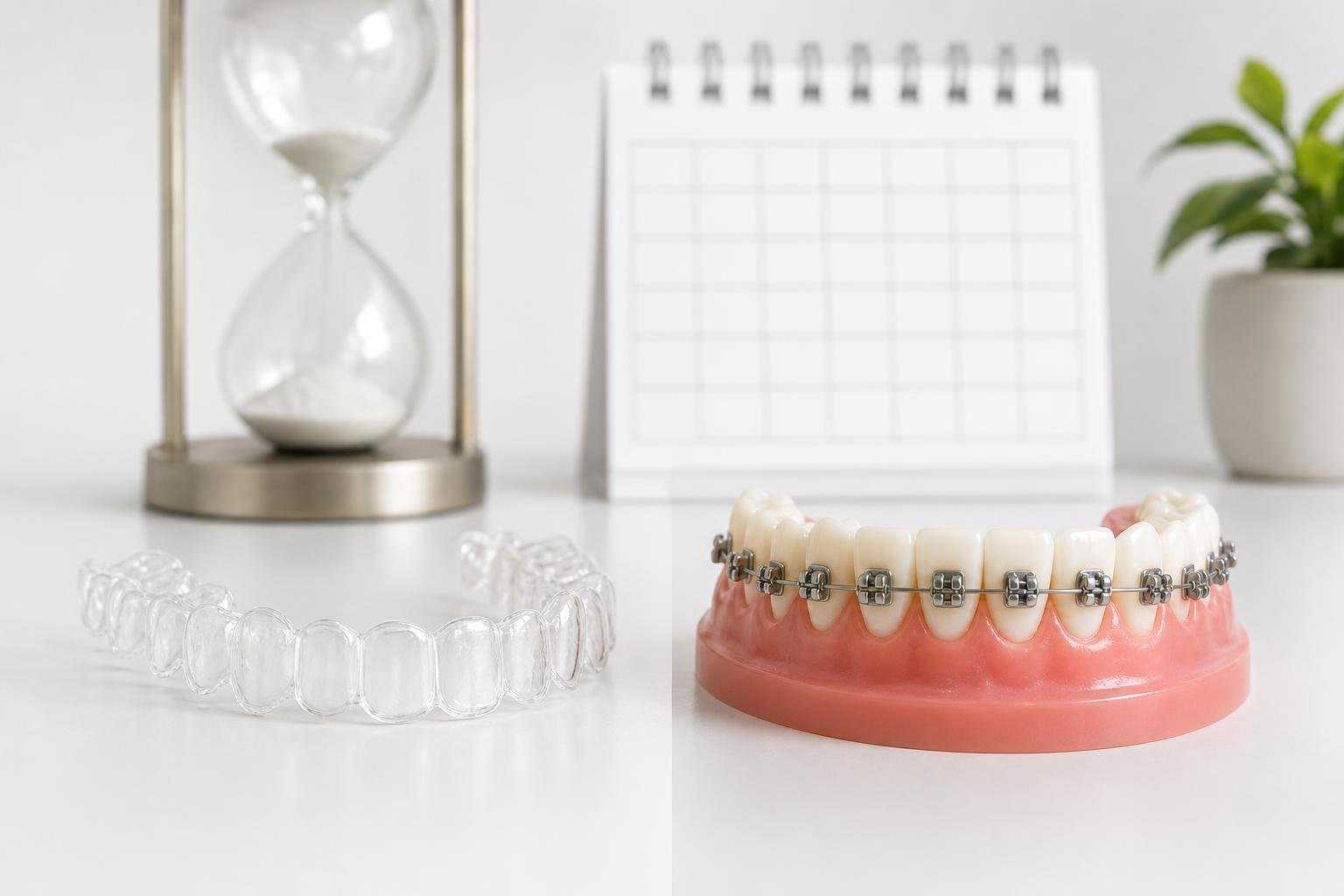
Invisalign vs Braces: How Long to Straighten Teeth? 150 150 Aileen Strive

Invisalign vs Braces: How Long to Straighten Teeth?

How Long Does Orthodontic Treatment Actually Take?

Invisalign duration vs braces

If you are comparing Invisalign treatment time with braces treatment time, the honest answer is that it depends on your teeth, your bite, and how consistently you follow the plan.

Neither option is automatically faster for every patient, but there are clear patterns that can help you understand what may suit your situation.

Key Takeaways

  • Clear aligners can be an efficient option for mild to moderate alignment concerns when they are worn as directed.
  • Braces are often more predictable for complex tooth movements, severe crowding, and significant bite issues.
  • Invisalign or other clear aligner treatment can take longer if refinements are needed or aligners are not worn consistently.
  • Your treatment time depends more on case complexity and clinical planning than on the appliance alone.
  • A consultation with a specialist orthodontist is the best way to compare your likely treatment timeline.

Key Takeaways

  • Clear aligners may be suitable for addressing mild to moderate alignment issues.
  • Traditional braces remain highly predictable for complex tooth movements and severe malocclusions.
  • Consistent daily wear is essential for keeping clear aligner treatment on schedule, as detailed in our The Complete Guide to Invisible Braces.
  • Refinement phases are common with aligners and can extend the overall treatment timeline.
  • Understanding the total investment for each option is easier with transparent pricing, which you can review on our pricing page.

Understanding Invisalign Treatment Time Compared with Braces

When we compare orthodontic options, the main question is not simply which system is faster. The better question is which system can move your teeth predictably for your particular bite.

Braces use metal or ceramic brackets bonded to the teeth and connected by an archwire. They work continuously because they stay fixed in place. Clear aligners, including Invisalign and Spark clear aligners, use a series of removable, custom-made trays that guide the teeth gradually from one stage to the next.

For some mild to moderate cases, clear aligners may offer a very efficient timeline. For more complex movements, braces can be more predictable because your orthodontist has direct control over each tooth throughout treatment.

Here is a simple way to think about it:

Mild Cases

For minor crowding, small spaces, or simple alignment issues, clear aligners may be a convenient and efficient option. Braces can also work very well, but some patients prefer aligners because they are removable and less noticeable.

Moderate Cases

For moderate cases, treatment time becomes more individual. Clear aligners may still be suitable, especially for patients who wear them consistently. Braces may be recommended if the tooth movements need more direct control.

Severe Cases

For severe crowding, complex bite problems, or difficult tooth rotations, braces are often the more predictable option. Clear aligners can still be useful in selected cases, but the timeline may be longer and may involve extra refinement stages.

You can read more about fixed appliance timelines in our guide to how long braces take.

What Affects Your Orthodontic Timeline?

Treatment time is not just about choosing Invisalign or braces. It is about your starting point, your goals, your biology, and how carefully the treatment is planned.

Case Complexity

The more complex the tooth movement, the more important predictability becomes. Mild crowding and spacing may respond well to clear aligners, while severe bite issues, significant rotations, and vertical tooth movements often suit braces better.

If you are still comparing the two systems, our pages on Invisalign and braces explain how each option works in more detail.

Aligner Wear Time

With braces, the appliance is fixed to your teeth and works all day. With clear aligners, you are in control because the trays are removable.

That flexibility is one of the reasons many adults and teens like aligners, but it also means consistency matters. If aligners are left out too often, the teeth may not track as planned. That can lead to delays, extra scans, or replacement trays.

In practical terms, clear aligners need to be worn for the recommended daily wear time and removed only for eating, drinking anything other than water, and cleaning your teeth.

Refinement Aligners

Many clear aligner cases include a refinement stage. This means your orthodontist takes a new digital scan and orders extra trays to fine-tune the final tooth positions or bite.

Refinements are not a failure. They are a normal part of many aligner plans. However, they can add several weeks or months to the overall treatment time, which is why the first estimate should always be treated as a guide rather than a guarantee.

When Braces May Be More Predictable

Clear aligners have improved a lot, especially with better materials and tooth-coloured attachments that help the trays grip the teeth. Even so, braces are still highly reliable for certain types of movement.

Braces may offer a more predictable timeline for:

  • Severe crowding: When teeth are heavily overlapped and need careful space management.
  • Complex rotations: Some teeth are harder for plastic aligners to grip and turn accurately.
  • Vertical movements: Moving teeth up or down can be more predictable with fixed appliances.
  • Significant bite issues: Deep bites, underbites, and other complex bite problems may need the continuous control of braces.

If your case involves these movements, braces may be the more direct path. For a deeper look at fixed appliances, see our metal dental braces guide.

Invisalign Treatment Time Versus Braces for Teens and Adults

Adults often like clear aligners because they are discreet and can be removed for meals, work, and social occasions. When adult patients wear them as directed, aligners can be a very practical option.

For teenagers, the decision depends on habits and responsibility. Some teens do very well with aligners. Others are better suited to braces because there is no need to remember trays, track wear time, or worry about losing them at school or sport.

Keeping Your Result After Treatment

Whether you choose clear aligners or braces, the final stage is the same: retention. Once your teeth are straight, they need support while the bone and gum tissues settle around their new positions.

Without retainers, teeth can slowly move back towards where they started. This is called relapse, and it can happen after any type of orthodontic treatment.

A retention plan may include:

  • Fixed wire retainers: A thin wire bonded behind the front teeth to help hold them in place.
  • Clear plastic retainers: Custom retainers worn as instructed, often overnight, to maintain the upper and lower arches.

Wearing retainers properly is one of the simplest ways to protect the time, effort, and money you have invested in treatment.

Choosing the Right Timeline for Your Smile

Choosing between clear aligners and braces is a personal decision, and it is best made after a proper orthodontic assessment. At NK Orthodontist, we have been helping Brisbane families with specialist orthodontic care since 1995.

Dr Nick personally sees every patient at every appointment, so your treatment is never delegated. From our Chermside and Spring Hill practices, we can talk you through the likely treatment time, comfort, cost, and predictability of each option.

We also offer transparent pricing with no hidden fees and interest-free payment plans, so you can make the decision with confidence.

If you are ready to compare your options, you can book a consultation with NK Orthodontist.

Frequently Asked Questions

Does Invisalign Take Longer Than Braces?

Invisalign may take longer or shorter than braces depending on your case. Mild to moderate cases with excellent aligner wear can progress efficiently, while complex cases may be faster or more predictable with braces.

Is the Final Result with Invisalign as Good as Braces?

For many mild to moderate cases, clear aligners and braces can both achieve excellent results. For complex bite problems or difficult tooth movements, braces may give your orthodontist more direct control.

Why Do Clear Aligners Sometimes Need Refinements?

Refinements help fine-tune tooth positions when the first set of aligners has not achieved every planned movement. They are common in aligner treatment and can add extra time to the overall plan.

How Many Hours a Day Do I Need to Wear Clear Aligners?

You need to wear clear aligners for the daily wear time recommended by your orthodontist. They should usually only come out for eating, drinking anything other than water, and cleaning your teeth.

Can Clear Aligners Correct Severe Bite Issues as Quickly as Braces?

Sometimes, but not always. Braces are often more predictable for severe bite issues because they apply continuous force and allow detailed control of tooth movement.

Do I Need to Wear a Retainer After Clear Aligner Treatment?

Yes. Retainers are needed after any orthodontic treatment, including clear aligners and braces. They help keep your teeth in their new positions and reduce the risk of relapse.

How Do I Maintain My Clear Aligners During Treatment?

Rinse your aligners with lukewarm water, brush them gently with a soft toothbrush, and clean your teeth before putting them back in. Avoid hot water, as it can distort the plastic.

How Does Case Complexity Affect Clear Aligner Predictability?

Clear aligners are often predictable for mild crowding and spacing. More complex movements, such as severe rotations or vertical changes, may be less predictable and may suit braces better.

braces for overbite
Biting Back: How Braces Can Correct Your Overbite 820 470 Aileen Strive

Biting Back: How Braces Can Correct Your Overbite

Is an Overbite Holding You Back? Here’s What Braces Can Do

If your front teeth overlap more than they should, you might be wondering whether braces can help. The good news is that braces for overbite correction can often improve both the way your bite functions and the way your smile looks, without surgery in many cases.

Key Takeaways

  • An overbite is when the upper front teeth overlap the lower front teeth too much vertically.
  • Braces can often correct dental overbites by moving the teeth into a healthier position.
  • More complex jaw-related overbites may need extra orthodontic support, and only a specialist assessment can confirm the best path.
  • Treatment time varies, but your orthodontist will explain what is realistic for your teeth, bite, and age.
  • Elastics, bite turbos, clear aligners, or growth modification appliances may be used alongside braces depending on your case.

Why It Helps to Get an Overbite Checked Early

If you are concerned about your bite, an early orthodontic assessment can help identify whether the issue is mainly tooth-related, jaw-related, or a combination of both. This is especially helpful for children and teenagers, because the jaw is still developing.

For adults, it is still very possible to improve an overbite, provided the teeth, gums, and supporting bone are healthy. The right treatment simply depends on what is causing the bite problem and how much correction is needed.

If you would like to compare modern treatment choices, our braces options page is a helpful place to start. You can also review our orthodontic pricing if you want to understand treatment investment before booking.

I’m Dr Nick, a Specialist Orthodontist with decades of experience treating complex bite issues, including braces for overbite cases across all age groups. In this guide, I’ll walk you through how overbites are assessed, what treatment can involve, and how to find the right approach for your smile.

Understanding Overbites: Dental vs. Skeletal Variations

An overbite refers to the vertical overlap between your upper and lower front teeth. A small amount of overbite, usually around 2 to 4 millimetres, is common and can support normal chewing function. When the overlap is greater than this, it may be described as an increased overbite or deep bite.

It is also worth knowing the difference between an overbite and an overjet. An overjet is the horizontal distance that the upper teeth sit in front of the lower teeth. People often mix these terms up, but they describe different bite concerns and may need different treatment plans.

Overbites generally fall into two main categories:

  • Dental overbites: These happen when the teeth are misaligned, crowded, or tilted, while the jaw bones are reasonably balanced.
  • Skeletal overbites: These are linked more closely to jaw development. For example, the lower jaw may be smaller or positioned further back than the upper jaw.

Genetics play a major role in how your jaw and teeth develop. Childhood habits, such as prolonged dummy use, thumb-sucking past early childhood, or tongue-thrusting patterns, can also affect the way the teeth and dental arches develop. In adults, losing back teeth can sometimes contribute to a deeper bite as the front teeth take more pressure and shift over time. Understanding the cause helps your orthodontist decide whether braces alone are likely to be enough.

How Braces for Overbite Correction Work

Orthodontic treatment uses gentle, steady pressure to guide teeth into better positions. With braces, brackets and wires work together over time to move the teeth while the surrounding bone naturally remodels around the roots.

To reduce a deep vertical overlap, your orthodontist may use specific movements such as:

  • Intrusion: Moving the front teeth slightly upward into the jawbone to reduce the overlap.
  • Extrusion: Encouraging the back teeth to erupt further, which helps open the bite and reduce the deep overlap at the front.

Several extra components may also help guide the bite into a healthier position. Elastics, or small rubber bands, are often stretched between the upper and lower braces to help align the arches. Bite turbos, which are small acrylic or metal blocks placed temporarily on the back of the front teeth, can stop you from biting all the way down and protect the lower brackets.

For growing children, growth modification appliances may help guide jaw development while the bones are still changing. If you want to understand the parts of braces in more detail, our metal braces guide explains how brackets, wires, and adjustments work together.

Treatment Options for Aligning Your Bite

Every smile is different, so the best option depends on your bite, your lifestyle, and how much movement is needed.

Treatment Type Description Best Suited For
Metal braces Stainless steel brackets and wires that allow precise control of tooth movement. Complex dental or skeletal overbites needing significant correction.
Clear ceramic braces Tooth-coloured ceramic brackets that are less noticeable than metal braces. Patients wanting a more discreet option during comprehensive treatment.
Spark clear aligners Custom clear trays planned digitally to move teeth gradually. Mild to moderate dental overbites where a removable option is suitable.
Invisalign Clear removable aligners used to guide planned tooth movement. Mild to moderate alignment concerns where discretion is a priority.

Traditional metal braces remain a very reliable option for complex bite correction because they give your orthodontist strong control over vertical tooth movement. Clear ceramic braces work in a similar way but are less visible.

Clear aligners, including Spark and Invisalign, can also be suitable for mild to moderate dental overbites when worn as directed. They use a series of custom trays to move teeth in stages, but they do rely heavily on consistent wear.

For severe skeletal discrepancies in adults, braces or aligners may sometimes be combined with jaw surgery. That is not the usual pathway for most patients, but it can be the right option when the jaw position cannot be corrected with tooth movement alone. You can compare these choices further in our guide to treatment options for misaligned teeth.

The Orthodontic Process: What to Expect

Correcting an overbite is a step-by-step process, and each stage is designed to keep your treatment accurate, comfortable, and stable.

Initial Consultation and Clinical Planning

Your first step is an in-person clinical assessment. During this visit, we take digital photographs, X-rays, and 3D digital scans of your teeth. This helps us understand the relationship between your teeth and jaw before recommending an appliance.

Active Treatment Phase

Once your braces or clear aligners are fitted, the active phase begins. You will visit our Brisbane practice for regular adjustments, usually every four to eight weeks. During these appointments, we monitor your progress, adjust wires if needed, and provide new elastics when they are part of your plan.

Retention Phase

After active treatment is complete, retention keeps your new bite stable. Teeth naturally tend to drift, so retainers are essential. We usually recommend a combination of a fixed wire retainer behind the lower front teeth and clear removable retainers made in-house for overnight wear. For more detail on timing, read our guide on how long braces take.

Choosing Braces for Overbite Correction

The right approach depends on your overbite severity, facial profile, age, and lifestyle. Dr Nick personally assesses every patient and designs a tailored treatment plan, so your care is based on your own dental anatomy rather than a one-size-fits-all approach.

Living with Braces During Treatment

Braces do take a little getting used to, but most patients settle into the routine quickly. You will need to clean carefully around brackets and wires, avoid hard or sticky foods that can damage braces, and wear elastics exactly as prescribed if they are part of your treatment.

It is normal to feel mild tenderness for a few days after adjustments. That discomfort usually settles quickly and is a sign that your teeth are responding to treatment.

Frequently Asked Questions

What is the difference between an overbite and an overjet?

An overbite is a vertical overlap where the upper front teeth cover the lower front teeth too much. An overjet is the horizontal distance between the upper and lower front teeth. They are different bite issues, so they may need different orthodontic approaches.

Can braces fix an overbite without surgery?

Yes, many overbites can be treated without surgery, especially when the issue is mainly dental. Surgery is usually considered only for adults with severe skeletal discrepancies where the jaw bones are significantly mismatched.

How long does it usually take to correct an overbite?

Many overbite treatments take around 12 to 24 months, but timing depends on the complexity of the bite, the patient’s age, and how well elastics or aligners are worn. Your orthodontist will give you a clearer estimate after assessing your teeth and jaw.

What is the best age to address an overbite?

The best time to assess a developing overbite is during childhood or early adolescence, while the jaw is still growing. Adults can still have successful overbite correction, as long as the teeth, gums, and supporting bone are healthy.

Are clear aligners as effective as traditional braces for overbites?

Clear aligners can work well for mild to moderate dental overbites when worn consistently. Traditional braces are often preferred for more severe deep bites or complex cases because they provide strong control over vertical tooth movement.

Why is retention important after overbite correction?

Retention matters because teeth can shift after active treatment ends. Wearing your retainers as directed helps protect the result and keeps your bite stable over the long term.

Ready to Find Out What Your Bite Needs?

If you are thinking about orthodontic treatment for an overbite, the best next step is a specialist assessment. NK Orthodontist has helped Brisbane families achieve healthier, more balanced bites since 1995. Dr Nick has over 30 years of clinical experience and personally oversees every appointment, so your treatment is never delegated.

We operate from two convenient Brisbane locations in Chermside and Spring Hill. Please note that our Spring Hill practice at 400 Gregory Terrace will undergo a temporary closure from August to September 2026, so please check our current practice status when scheduling your visit. We also offer transparent, all-inclusive pricing with no hidden fees, along with flexible interest-free payment plans.

Ready to begin? You can book an initial consultation or complete our online assessment form today. Book now to take the first step towards a healthier, more confident smile.

Braces Spring Hill
Spring Hill Braces Guide: Getting Your Smile Back on Track 864 1080 Aileen Strive

Spring Hill Braces Guide: Getting Your Smile Back on Track

Braces in Spring Hill: Your Guide to Specialist Orthodontic Care

Looking for braces in Spring Hill or nearby Brisbane? Here is a practical, plain-English guide to the options, what to expect at your first visit, and how NK Orthodontist can help you plan treatment with a Specialist Orthodontist.

I am Dr Nick, a Brisbane-based Specialist Orthodontist and the founder of NK Orthodontist. I personally see every patient at every appointment, so your care is guided consistently from consultation through to review visits.

Key Takeaways

  • Specialist care matters: A registered Specialist Orthodontist has dedicated postgraduate training in orthodontics and focuses on tooth movement, bite correction and growth guidance.
  • Your options are flexible: Metal braces, clear ceramic braces and clear aligners can suit different needs, lifestyles and preferences.
  • Early checks can be helpful: For children, an orthodontic assessment can help monitor jaw growth and identify whether treatment may be needed later.
  • Costs should be clear upfront: NK Orthodontist provides transparent treatment information, and you can review current details on the pricing page.
  • A consultation is the best starting point: A clinical assessment helps determine whether braces, aligners or another approach is appropriate for your smile.

About Dr Nick

I am Dr Nick, a registered Specialist Orthodontist with over 30 years of clinical experience in Brisbane. Since founding NK Orthodontist in 1995, I have treated more than 11,500 patients across our Chermside and Gregory Terrace locations.

My approach is personal and consistent. I see every patient at every appointment, so I can monitor treatment carefully and adjust the plan as your teeth respond.

Orthodontic Treatment Options in Brisbane

When you are comparing braces in Brisbane, it helps to understand what each option is designed to do. Some people need the control of fixed braces, while others may be suitable for a more discreet aligner system.

Traditional Metal Braces

Traditional metal braces use stainless steel brackets and an archwire to guide teeth into better alignment over time. They are a well-established system and are often recommended when precise control is needed, particularly for more involved bite or spacing concerns.

Modern brackets are smaller and smoother than older styles, so many patients find them more comfortable than expected. Keeping your teeth and gums clean is still important during treatment, and our guide to caring for braces explains the daily habits that can help.

Clear Ceramic Braces

Clear ceramic braces work in a similar way to metal braces, but the brackets are designed to blend more subtly with your teeth. They can be a good option if you want the control of fixed braces with a less noticeable appearance.

During your consultation, we will talk through whether ceramic braces suit your bite, your treatment goals and your day-to-day routine.

Clear Aligners and Spark Aligners

Clear aligners are removable trays that gradually guide teeth into planned positions. Because you take them out for eating, brushing and flossing, they can fit well into busy work, school and family routines.

At NK Orthodontist, we offer Spark aligners and Invisalign. They are not the right fit for every case, so we assess your teeth, bite and goals before recommending them.

Orthodontic Care for Children, Teens and Adults

Orthodontic treatment is not only for teenagers. People visit us at different stages of life, from parents bringing children in for an early assessment to adults wanting to improve alignment or prepare for future dental work.

Treatment Category Main Focus Common Options
Early assessment Monitoring growth, tooth eruption and developing bite concerns Review visits, partial appliances where clinically appropriate
Teen treatment Aligning permanent teeth and managing bite concerns Metal braces, ceramic braces, clear aligners
Adult orthodontics Addressing crowding, spacing, bite issues or relapse from earlier treatment Ceramic braces, Spark aligners, Invisalign

Children’s Orthodontic Assessments

A child’s first orthodontic visit is usually about information, not rushing into treatment. We look at jaw growth, the way adult teeth are coming through and whether there are signs that may need monitoring.

In some cases, early intervention may help guide development or make later treatment more straightforward. In other cases, the best plan is simply to review growth over time.

Discreet Options for Adults

Many adults want orthodontic treatment that fits around work, family and social commitments. Clear ceramic braces and transparent aligners can offer a more low-profile way to address alignment concerns, depending on the complexity of the case.

If you are unsure where to start, our guide to braces for grown ups explains what adults commonly want to know before booking.

Digital Planning and Modern Orthodontic Technology

Digital technology helps us plan orthodontic treatment with more detail and comfort than older impression methods. Instead of relying only on traditional moulds, we can use digital scans to create a detailed model of your teeth.

That model helps us assess your bite, plan tooth movement and design appliances such as braces or clear aligners. Digital simulations are useful planning tools, but they are not a guarantee of an exact final result because every patient responds differently.

The main benefit is better information at the planning stage. When we can see your teeth and bite clearly, we can explain your options more clearly as well.

What Happens at Your First Orthodontic Consultation

Your first consultation is a chance to understand what is happening with your teeth and what options may suit you. You do not need to know whether you want braces or aligners before you come in. That is what the assessment is for.

You can book your first visit through our orthodontic consultation booking page.

The Initial Assessment

At the appointment, we examine your teeth and bite and may take diagnostic records such as photos or x-rays. This helps us understand the position of your teeth, how your jaws meet and whether there are any issues that need closer attention.

After that, we talk you through the findings in clear language. If treatment is recommended, you will receive a personalised plan and a transparent quote so you can make an informed decision.

Treatment Timing

Orthodontic timing varies from person to person. It depends on your bite, the amount of tooth movement needed, your appliance type and how your teeth respond during treatment.

For some people, treatment is relatively limited. For others, especially where bite correction is involved, a more comprehensive plan may be recommended.

Frequently Asked Questions

At what age should my child see an orthodontist?

A child can see an orthodontist once adult teeth are starting to come through and jaw growth can be assessed. The visit helps us identify whether anything needs monitoring or whether treatment may be useful later. Many children do not need treatment straight away.

How long does orthodontic treatment take?

Orthodontic treatment time depends on your individual needs. Minor alignment concerns may be more limited, while more involved bite correction generally needs a broader plan. We will explain the likely process after assessing your teeth and bite.

What is the difference between an orthodontist and a dentist?

A Specialist Orthodontist is a dentist who has completed additional full-time university training in orthodontics. Orthodontists focus on tooth movement, bite correction and jaw development. Dentists provide general dental care and may refer patients when specialist orthodontic planning is needed.

What are the pricing options for braces in Brisbane?

Pricing depends on the type and complexity of treatment recommended. NK Orthodontist provides clear quotes after your consultation, with no hidden fees. You can also review current treatment information on our pricing page.

How do I care for my teeth while wearing braces?

Good oral hygiene is important while wearing braces. Food and plaque can collect around brackets and wires, so brushing carefully and flossing with the right tools helps protect your teeth and gums. We will show you how to clean around your appliances properly.

Are clear aligners as effective as traditional braces?

Clear aligners can be effective for many orthodontic concerns, but they are not suitable for every case. Fixed braces may be recommended when more precise control is needed. We will compare the options with you after assessing your bite and tooth movement needs.

Planning Braces Care Around Our Brisbane Locations

If you are considering braces in Spring Hill, NK Orthodontist offers specialist care from a Brisbane practice founded in 1995. Our Gregory Terrace clinic is located at 400 Gregory Terrace, Brisbane QLD 4000, and our Chermside clinic is located at 510 Rode Road, Chermside QLD 4032.

Please note that our Gregory Terrace clinic will be temporarily closed from August to September 2026. During that period, Gregory Terrace patients will be welcomed at our Chermside practice so treatment can continue smoothly.

What makes our approach different is continuity. I personally see every patient at every appointment, which means your treatment is monitored by the same Specialist Orthodontist throughout your care.

If you are ready to take the next step, you can book a consultation for a clinical assessment and a personalised treatment plan.

Smiling orthodontic patient with a clear retainer case at a Spring Hill clinic
Spring Hill’s Guide to Keeping Your Smile Straight with Retainers 575 464 Aileen Strive

Spring Hill’s Guide to Keeping Your Smile Straight with Retainers

If you have recently finished orthodontic treatment, or your old retainer no longer fits, seeing an orthodontist for retainers can help you understand your options and maintain your smile.

Key Takeaways

  • Retainers help reduce gradual tooth movement after braces or clear aligner treatment.
  • Clear removable retainers can be cleaned using a straightforward daily routine and are discreet when worn.
  • Fixed bonded retainers can be useful in specific cases, but they need careful cleaning and regular checks.
  • NK Orthodontist uses digital scanning and in-house 3D printing to create accurate retainers in Brisbane.
  • If your retainer is lost, broken, or feels too tight, book a scan so we can assess your current fit.

Teeth can naturally change position over time. A properly fitted retainer is designed to help maintain the tooth position achieved during orthodontic treatment.

This guide walks you through your retainer options, how long you may need to wear one, what to do if yours is lost or broken, and when to book with Dr Nick at NK Orthodontist.

About the Author

I am Dr Nick, a Specialist Orthodontist with over 30 years of experience and more than 11,500 patients treated. At my practice, I personally see every patient to ensure the highest standard of specialist care.

Comparing Your Retainer Options

Choosing the right retainer is not something you need to figure out on your own. At our practice, we look at your original tooth position, your bite, your hygiene habits, and your lifestyle before recommending the most suitable option.

For many patients, clear removable retainers are a practical choice. They are discreet, can be cleaned using a straightforward daily routine, and can be taken out for meals, brushing, and flossing. In other cases, especially where a front tooth gap has been closed, a fixed bonded retainer may give extra support in a very specific area.

Feature Clear Removable Retainer Fixed Bonded Retainer
Material Thermoformed medical-grade polymer Medical-grade stainless steel wire
Visibility Virtually invisible when worn Hidden behind the teeth
Hygiene Removed for normal brushing and flossing Needs floss threaders or interdental brushes
Wear Schedule Full-time at first, then usually night-time only Continuous
Main Risk Forgetting to wear it A bond coming loose without being noticed

Clear Removable Retainers

Clear plastic retainers are made over a precise model of your teeth. At NK Orthodontist, we use digital scanning and in-house 3D printing to create a custom fit for your smile. Because the retainer covers the teeth closely, it helps hold them in their corrected position.

They are also straightforward to look after. You remove the retainer to brush and floss as usual, then clean the appliance separately with cool or lukewarm water and a suitable non-abrasive cleanser. For similar care principles, see our guide to caring for your clear aligners.

Fixed Bonded Retainers

A fixed bonded retainer is a fine wire attached to the back of the front teeth. It is hidden from view and works continuously, which can be helpful if there is a higher risk of a particular space reopening.

The trade-off is cleaning. Food and plaque can build up around a bonded wire if it is not cleaned properly, so you need to be comfortable using interdental brushes, floss threaders, or superfloss. It is also important to have the wire checked, because one loose bond can allow a tooth to move even while the rest of the retainer looks fine.

What Happens When You Get a Retainer?

Getting a custom retainer at NK Orthodontist starts with a digital scan. That means no messy impression trays. The scanner captures a 3D model of your teeth, which helps us create a retainer that fits accurately and comfortably.

Once the scan is complete, we use our in-house 3D printers to produce a physical model of your teeth. From there, we thermoform the clear retainer, trim it carefully, and check the fit before you leave.

Because this process is handled in-house, turnaround can often be much faster than sending everything to an outside laboratory. If you need a replacement or a fresh set, booking an in-person consultation at our Spring Hill or Chermside practice is the first step.

How Long Do You Need to Wear a Retainer?

If you want your teeth to stay straight, retention is usually a long-term commitment. The exact wear schedule can change over time, but most patients start with more frequent wear and gradually move to night-time wear once the teeth are more stable.

A helpful way to monitor things is the “tightness test”. When you put your retainer in at night, notice how it feels. If it feels tight, your teeth may have tried to move during the day. If it slips in comfortably, that is a good sign that your smile is staying stable. You can read more in our guide on how long to wear retainers after braces.

Lost, Broken, or Tight Retainer? What to Do Next

If you lose or break your retainer, book a scan so we can assess your current tooth position and retainer fit. This gives you clear guidance on whether a replacement retainer is suitable.

If your retainer still fits but feels snug, do not panic. In some cases, wearing it as directed may help settle minor movement. If it no longer fits properly, do not force it into place. That can put unwanted pressure on your teeth.

The next step is to arrange a new scan so we can check your current tooth position and make a properly fitted replacement if needed. Our guide to replacing a lost retainer explains what to do if yours has gone missing.

Retainer Care with Dr Nick

At NK Orthodontist, the retention phase is treated as an important part of your orthodontic care, not an afterthought. Whether you completed treatment with us or you are new to the area and need retainer care in Brisbane, we can help you keep your smile stable.

Dr Nick has cared for Brisbane families for more than three decades, with practices in Chermside and Spring Hill. You will see Dr Nick personally at each appointment, rather than having your care delegated to someone else.

Please note that our practice at 400 Gregory Terrace in Spring Hill will be temporarily closed from August to September 2026. If you need a new retainer during this period, please contact us to coordinate a visit at our Chermside practice, or book in July 2026 before the temporary closure begins.

We offer transparent pricing with no hidden fees, along with flexible interest-free payment options. If you are ready to discuss retainers, you can book now to secure your appointment.

Frequently Asked Questions

Can I get a same-day retainer in Spring Hill?

Same-day fabrication is often possible at our Spring Hill practice because we use digital scanning and an in-house 3D printing workflow. This helps reduce the time your teeth are left without support.

How much do retainers cost?

The cost depends on whether we already have a suitable model of your teeth or need to take a new digital scan. For current fees and payment options, please visit our pricing page.

What happens if my teeth shift after treatment?

If the shifting is minor and your retainer still fits, we may advise you to wear it more consistently for a period. If the retainer no longer fits, you may need a new scan and, in some cases, further orthodontic treatment.

Do you offer retainers for patients from other practices?

Yes. We regularly see patients who had treatment elsewhere and now need a new retainer in Spring Hill or Brisbane. We can take a fresh digital scan and make a retainer based on your current tooth position.

How do I clean and care for my clear retainer?

Clean it daily with cool or lukewarm water and a suitable non-abrasive cleanser. Avoid hot water, direct sunlight, car dashboards, and standard toothpaste, as heat can distort the retainer and abrasives can scratch it.

Should I choose a fixed or removable retainer?

That depends on your teeth, bite, and habits. Removable retainers are versatile and easy to clean, while fixed bonded retainers can be helpful in specific cases but need extra cleaning and regular checks.

Smiling orthodontic patient in a Brisbane clinic discussing ways to fix crowded teeth
How to Fix Overcrowded Teeth for a Happier Smile 864 1080 Aileen Strive

How to Fix Overcrowded Teeth for a Happier Smile

Why So Many Brisbane Smiles Start with Crowded Teeth

If you want to fix crowded teeth, you are not alone. Crowding is one of the most common reasons Brisbane families, teens and adults visit an orthodontist, and the right solution depends on your teeth, bite, jaw development and long-term smile goals.

Key Takeaways

  • Crowded teeth usually happen when there is not enough room in the jaw for the teeth to sit comfortably in line.
  • Braces, Spark aligners, Invisalign, interproximal reduction, expansion and, in some complex cases, extractions can all play a role.
  • Many patients can improve crowded teeth without removing teeth, but this depends on the severity of the crowding and the supporting bone.
  • A specialist assessment helps identify whether clear aligners, braces or another option will give the most stable result.
  • Retainers are essential after treatment because teeth can naturally shift again over time.

What Causes Dental Crowding?

Dental crowding usually comes down to a simple space problem: the teeth need more room than the jaw can comfortably provide. When that happens, teeth may overlap, twist, rotate or come through outside their ideal position.

Genetics often play a big role. You might inherit a smaller jaw from one parent and larger teeth from the other, which can leave the teeth competing for space as they develop.

Childhood dental development can also affect crowding. If baby teeth are lost early because of decay or injury, nearby teeth can drift into the gap. That can block the path for adult teeth and make alignment more difficult later on.

Late lower jaw growth can contribute too. Many adults notice their lower front teeth becoming more crowded over time, even if their teeth looked reasonably straight when they were younger.

Habits such as prolonged thumb sucking, mouth breathing or low tongue posture may also influence how the upper jaw develops during childhood. When the tongue does not rest naturally against the roof of the mouth, the upper arch may become narrower, leaving less room for adult teeth.

Why Fixing Crowded Teeth Matters for Oral Health

Many people want to fix crowded teeth because they feel self-conscious about their smile, but the health benefits matter just as much. When teeth overlap or sit tightly together, they create small spaces that are difficult to clean properly.

Those tight areas can trap plaque and tartar. Over time, that can increase the risk of tooth decay, gum inflammation and more serious gum problems. Straighter teeth are usually easier to brush and floss, which makes daily oral care more effective.

Crowding can also affect the way your upper and lower teeth meet when you bite and chew. If some teeth carry more pressure than others, they may be more prone to uneven wear, enamel strain or small fractures.

In some cases, an uneven bite can also place extra stress on the jaw joints and surrounding muscles. That is why orthodontic treatment is not only about appearance. It can support better comfort, function and long-term dental health.

Modern Orthodontic Options to Fix Crowded Teeth

Modern orthodontic treatment is planned around your teeth, bite, jaw development and facial profile. At NK Orthodontist, digital modelling helps Dr Nick assess how much space is available and what kind of tooth movement is needed before recommending a treatment pathway.

For adults, the plan may involve carefully guided tooth movement, arch development or minor enamel reshaping. For children and teens, growth-guided options may be considered when timing and development make them suitable.

Traditional Braces and Ceramic Braces

Traditional braces are a reliable option for many cases of dental crowding, including moderate to severe crowding. Brackets are attached to the teeth and connected with archwires, which guide each tooth into a better position over time.

Ceramic braces may suit patients who want a more discreet look. These brackets are designed to blend more naturally with the colour of the teeth, so they are less noticeable than metal braces from a distance.

Braces can be especially helpful when teeth are significantly rotated, tipped or blocked out because of limited space. They give the orthodontist strong control over both the tooth crowns and roots, which is important for stable alignment. You can compare treatment types in our guide to braces types.

Clear Aligners, Spark Aligners and Invisalign

Clear aligners can be a good option for many mild to moderate crowding cases. They use a series of clear, removable trays that gradually guide the teeth into their planned positions.

At NK Orthodontist in Brisbane, Dr Nick offers Spark aligners and Invisalign where clinically appropriate. Spark aligners are his preferred aligner system, and Invisalign is also available for suitable cases.

Because aligners are removable, you can take them out for eating, brushing and flossing. The important part is consistency. Aligners only work well when they are worn for the recommended hours each day and reviewed regularly by your orthodontist. You can learn more in our guide to clear aligners.

Can Crowded Teeth Be Fixed Without Extractions?

A lot of patients worry that fixing crowded teeth automatically means removing healthy teeth. In many cases, it does not. Extractions are sometimes needed for severe crowding, especially when there is not enough bone support to safely create space another way, but they are not the first choice for every patient.

At NK Orthodontist, non-extraction options may be considered whenever they are clinically suitable. Two common ways to create space include:

  • Arch expansion: In growing children, expansion appliances may help widen the dental arch and create more room for adult teeth to come through.
  • Interproximal reduction: For some adult patients, a very small amount of enamel can be polished between selected teeth. This is measured carefully and may help create the extra space needed for mild to moderate crowding.

The right approach depends on your age, the amount of crowding, your bite, your gum and bone support, and your facial profile. A specialist assessment is the safest way to understand whether braces, aligners, IPR, expansion or extractions may be appropriate for you. For more adult treatment context, read our guide to fixing crooked teeth as an adult.

Ready to Talk About Your Crowded Teeth?

If you are ready to do something about crowded teeth, the next step is a proper orthodontic assessment. At NK Orthodontist, Dr Nick Kotsomitis has been helping Brisbane patients achieve healthier, more confident smiles for more than 30 years.

Your care is personal from start to finish. Dr Nick sees every patient at every appointment, so your treatment is planned, monitored and adjusted by a Specialist Orthodontist rather than delegated.

NK Orthodontist welcomes patients at Chermside, located at 510 Rode Road.

You will also receive clear information about costs before you begin. Consultations are $90, interest-free payment plans are available, comprehensive treatment usually ranges from $7,000 to $9,500, and minor alignment starts from $3,500. You can find more detail on the pricing page.

If you would like to understand your options, you can book a consultation with Dr Nick and take the first step towards a healthier, more comfortable smile.

Frequently Asked Questions

Can crowded teeth be fixed without removing any teeth?

Many cases of dental crowding may be treated without extractions, depending on your teeth, bite, age and bone support. Dr Nick may consider options such as arch expansion for growing children or interproximal reduction for suitable adults after an in-person assessment.

How long does it take to fix crowded teeth?

Treatment time depends on the complexity of the crowding. Mild cases may take a shorter period, while moderate to severe crowding usually needs longer active treatment. At your consultation, Dr Nick can give you a personalised estimate based on your teeth and bite.

Is fixing crowded teeth painful?

You may feel temporary pressure or mild tenderness when braces are adjusted or when you change to a new aligner. This is a normal part of tooth movement and usually settles within a few days.

Can I use mail-order aligners to fix crowded teeth?

Crowded teeth are best assessed in person by a qualified orthodontist, because tooth movement involves the teeth, gums, supporting bone and bite. A specialist assessment and regular reviews help make sure your treatment plan is suitable for your mouth and adjusted when needed.

Why are my bottom teeth becoming crowded as I get older?

Lower front teeth often become more crowded with age because of natural jaw changes and everyday bite forces. Retainers are the best way to help prevent teeth from shifting after orthodontic treatment.

Does private health insurance cover treatment for crowded teeth?

Some Australian private health insurance policies provide rebates for orthodontic treatment under major dental extras. The amount depends on your fund and level of cover. NK Orthodontist can provide item codes so you can check your rebate with your insurer.