

Why Modern Orthodontic Treatments are a Game Changer
Modern orthodontic treatments have expanded well beyond traditional metal braces, giving patients in Brisbane and across Australia more choices than ever before.
Key Takeaways
- Consult a specialist orthodontist to evaluate your unique dental structure and discuss tailored options.
- Explore clear aligners as a highly discreet option for mild to moderate alignment needs.
- Consider early orthodontic evaluation to guide proper jaw development in growing children.
- Review transparent, comprehensive pricing plans to find a solution that fits your family budget.
At a glance: modern orthodontic treatment options:
| Treatment | Best suited for | Key feature |
|---|---|---|
| Metal braces | Mild to complex cases | Reliable, precise control |
| Ceramic braces | Teens and adults | Tooth-coloured, less visible |
| Clear aligners (Invisalign/Spark) | Mild to moderate alignment | Removable, discreet |
| Self-ligating braces | A range of cases | Reduced friction brackets |
| Lingual braces | Adults wanting full discretion | Placed behind the teeth |
| Surgical orthodontics | Complex skeletal cases | Combined with jaw surgery |
The field has changed significantly over the past two decades. Digital scanning, AI-assisted planning, and custom-fabricated appliances have all become part of how specialist orthodontists assess and treat patients today. Whether you are a parent looking at options for your child, a teenager wanting something discreet, or an adult considering treatment for the first time, understanding what is available is the right place to start.
I’m Dr Nick, a Specialist Orthodontist based in Chermside, Brisbane, with over 30 years of clinical experience and a career focused exclusively on orthodontics across which I have provided specialist care to more than 11,500 patients. I’ve worked with modern orthodontic treatments throughout that time, and in this guide I’ll walk you through everything you need to know to make a confident, informed decision.
The Evolution of Modern Orthodontic Treatments
Orthodontics is the oldest dental specialty. It has evolved from a purely mechanical focus on aligning teeth to a comprehensive discipline that considers facial harmony, airway health, and long-term joint function.
Traditional metal braces remain a highly reliable option for many families. They consist of stainless steel brackets bonded to the front of the teeth, connected by an archwire that guides the teeth into position. Modern versions of these braces are smaller, sleeker, and far more streamlined than the designs used decades ago.
Ceramic braces offer a less visible alternative for patients who prefer a subtle appearance. These appliances function in the same way as metal braces but utilise translucent or tooth-coloured materials that blend in with your natural teeth. Choosing between these options depends on your lifestyle, aesthetic preferences, and clinical needs. You can read more info about choosing your best fit to help you weigh these options.
The introduction of clear aligners has further transformed the clinical landscape. This technology has changed how we plan and execute tooth movement, making treatment more integrated into daily life. For a broader look at how these developments are changing the dental field, you can read about How Modern Orthodontic Treatments Are Reshaping Dental Care.
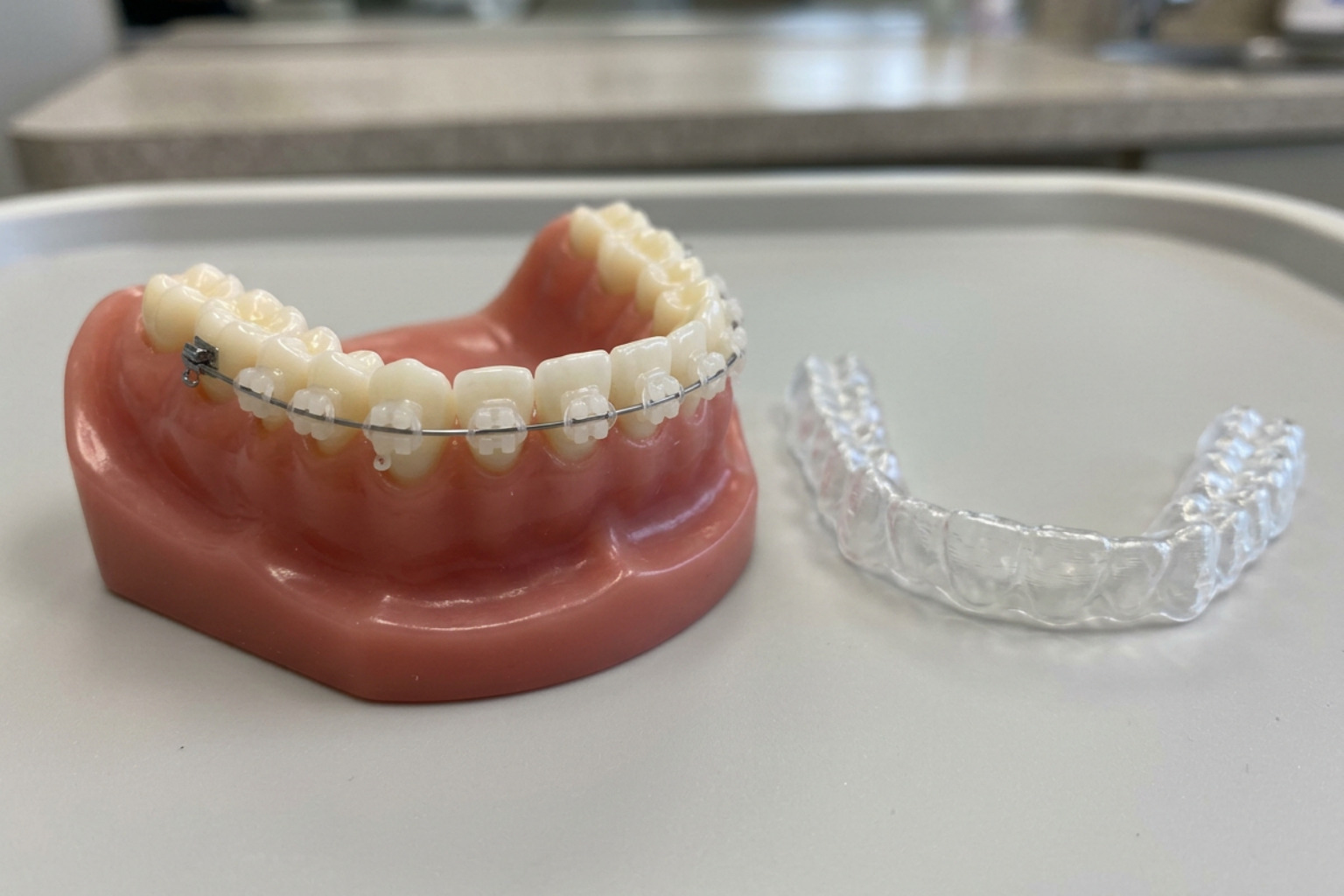
Clear Aligners vs. Conventional Braces
Clear aligners have become highly popular among both adults and teenagers in Brisbane. Instead of brackets and wires, this system uses a sequence of custom-moulded plastic trays to guide teeth into their planned positions.
We offer both Invisalign and Spark clear aligners at our Chermside practice. Both systems utilise medical-grade, BPA-free polyurethane polymers to apply targeted, incremental forces to the teeth. Each tray in the series moves the teeth by a fraction of a millimetre before the patient switches to the next set.
Clear aligners are removable, which means you can take them out to eat, brush, and floss. This feature requires a high level of patient compliance, as the aligners must be worn for the vast majority of the day to work effectively.
Conventional braces are fixed to the teeth, meaning they work continuously without relying on the patient to remember to wear them. This makes fixed braces a highly reliable option for younger patients or complex cases that require precise, three-dimensional control over root movement.
| Feature | Clear Aligners (Spark/Invisalign) | Conventional Fixed Braces |
|---|---|---|
| Visibility | Highly discreet, clear polymer trays | Visible metal or tooth-coloured ceramic brackets |
| Removability | Removable for eating and cleaning | Fixed to the teeth for the duration of treatment |
| Compliance | Requires self-discipline to wear consistently | Works continuously without patient intervention |
| Suitability | Excellent for mild to moderate cases | Ideal for all cases, including complex structural issues |
| Planning | Fully digital setup from the beginning | Step-by-step adjustments during clinical visits |
Advanced Fixed Appliances and Custom Systems
Fixed appliances have benefited from significant technological progress. Modern braces are designed to reduce friction and improve the clinical experience.
Self-ligating braces are an advanced variation of fixed appliances. Traditional braces use tiny elastic bands or metal ties to secure the archwire to the brackets. Self-ligating systems utilise a built-in sliding clip or door to hold the wire in place. This design reduces the friction between the wire and the bracket, allowing the teeth to move more freely.
Clear ceramic braces remain a highly sought-after custom system. They combine the reliable mechanics of fixed braces with polycrystalline ceramic materials that resist staining. This makes them an excellent choice for individuals who require the control of fixed braces but prefer a low-profile look.
Discreet Options in Modern Orthodontic Treatments
Adults now make up a significant portion of patients seeking orthodontic care in Brisbane. Many adult patients prefer discreet options that do not interfere with their professional or social lives.
Lingual braces represent the ultimate in discreet fixed orthodontics. These braces are custom-made and bonded to the back of the teeth, making them completely hidden from view. They provide the precise control of traditional braces while remaining entirely invisible from the front.
Ceramic braces and clear aligners are also excellent options for adult orthodontics. These systems allow adults to address long-standing alignment concerns without feeling self-conscious.
Digital Innovation and AI-Assisted Planning
The integration of digital technology has redefined how we diagnose, plan, and execute modern orthodontic treatments. We no longer rely on uncomfortable putty impressions to capture the shape of your teeth.
Instead, we use high-resolution intraoral 3D scanning to capture thousands of data points per second. This process creates a highly accurate, three-dimensional digital model of your teeth and bite. I use this digital modeling for clinical planning to analyse your dental anatomy from every angle. It is important to note that while we utilise these advanced surface scanners, we do not offer or perform 3D CBCT scans at our clinic.
Computer-aided design (CAD) and computer-aided manufacturing (CAM) allow us to design custom appliances with extreme precision. We can plan exact tooth movements and even utilise 3D printing to fabricate custom aligner templates.
The Role of AI in Modern Orthodontic Treatments
Artificial intelligence is playing an increasingly important role in clinical planning and monitoring. AI-assisted digital workflows help orthodontists analyse complex dental patterns and simulate tooth movements with high precision.
By using AI algorithms to help segment teeth and identify anatomical landmarks, we can plan movements with a high level of detail. This technology serves as an assistant to my clinical decision-making, ensuring that every plan is tailored to the patient’s unique anatomy.
Surgical Orthodontics and Complex Adult Cases
Some orthodontic concerns involve structural skeletal discrepancies that cannot be addressed by moving the teeth alone. When the upper and lower jaws do not align correctly, surgical orthodontics may be considered.
Orthognathic surgery is a collaborative treatment performed by a specialist orthodontist and an oral and maxillofacial surgeon. This approach is typically reserved for non-growing adult patients with severe skeletal discrepancies. The process involves using braces or clear aligners to align the teeth within each jaw, followed by surgical repositioning of the jaws to establish a balanced relationship. Please note that we do not offer temporary anchorage devices (TADs) or Miniscrew-Assisted Rapid Palatal Expansion (MARPE) at our practice; for complex skeletal corrections, we rely on established surgical orthodontic collaboration.
Surgical orthodontics can help address severe bite imbalances and improve overall facial harmony. It is a comprehensive treatment plan that requires careful planning and a commitment to long-term care.
Retention Protocols and Long-Term Stability
Achieving a beautifully aligned smile is only the first phase of orthodontic care. Maintaining that alignment over the course of your life requires a dedicated retention protocol.
Teeth are supported by a complex network of periodontal ligaments and bone. Once active orthodontic appliances are removed, these tissues require time to reorganise and stabilise around the new tooth positions. Natural aging and muscle forces also exert continuous pressure on the teeth, which can cause them to shift over time if they are not supported.
We use two main types of retainers to prevent relapse:
- Fixed wire retainers: A thin, custom-fitted wire bonded discreetly to the back of the front teeth. This wire provides continuous, passive support to keep the highly visible front teeth in place.
- In-house clear plastic retainers: Clear, custom-moulded plastic trays that fit snugly over the teeth. These are typically worn full-time immediately after treatment, transitioning to night-wear as the surrounding tissues stabilise.
Lifelong retention is the only reliable way to ensure your teeth remain in their planned positions.
Your Next Step with Dr Nick
At NK Orthodontist, we believe that choosing orthodontic care is an important decision for your family. I have spent more than 30 years refining my clinical approach to ensure that every patient receives highly personalised, specialist care.
When you visit our Chermside location, you will see me at every single appointment. I do not delegate clinical care to assistants or hygienists. This continuity of care allows me to monitor your progress closely and adjust your treatment plan dynamically as your teeth respond.
We are committed to making quality orthodontic care accessible. We offer transparent, comprehensive pricing with no hidden fees, alongside flexible interest-free payment plans designed to fit your family budget. With over 565 five-star Google reviews reflecting our patient-first communication and service, you can feel confident that you are in experienced hands.
If you are ready to explore your options, please Book a consultation with Dr Nick today. I look forward to meeting you and discussing how we can help you achieve a healthy, aligned smile.
Frequently Asked Questions
What is the recommended age for a child’s first orthodontic evaluation?
A child’s first orthodontic evaluation is most effective during early childhood when the jaw is still growing. This timing allows a specialist orthodontist to monitor dental development and determine if early interceptive options may help guide proper jaw growth. By assessing development early, we can sometimes simplify future treatment needs if complex alignment issues begin to emerge.
Are clear aligners as effective as traditional braces?
Clear aligners can be highly effective for addressing mild to moderate alignment concerns. For more complex dental movements or skeletal discrepancies, traditional braces may offer the precise control required to achieve the desired clinical outcome. A comprehensive clinical assessment is necessary to determine which modality is most appropriate for your specific dental structure.
How long does modern orthodontic treatment typically take?
The duration of orthodontic treatment varies significantly depending on the complexity of the individual case and the specific appliance used. Some mild alignment concerns may be addressed within a shorter timeframe, while comprehensive cases involving bite correction typically require a longer period. I will provide a personalised estimation of your treatment timeline after a thorough clinical examination.
Will I need to wear a retainer after my treatment is complete?
Yes, wearing a retainer is a vital phase of any orthodontic treatment to maintain long-term stability. Teeth have a natural tendency to shift over time due to natural aging and jaw changes. Utilising fixed wire or in-house clear plastic retainers as directed helps preserve the alignment achieved during the active phase of your care.
What are the features of Spark clear aligners?
Spark clear aligners utilise an advanced medical-grade polymer designed to guide tooth movement discreetly and efficiently. This system is designed for clarity and stain resistance, making it a popular choice for adults and teenagers alike. During your consultation, I will evaluate your clinical needs to determine if this custom aligner system is the right fit for your treatment plan.
How does digital modeling assist in orthodontic planning?
Digital modeling for clinical planning utilises high-resolution intraoral scans to create a three-dimensional representation of your teeth and jaws. This technology allows me to analyse your bite from multiple angles and plan precise tooth movements before any appliances are fabricated. It serves as a highly detailed diagnostic tool to help customise your treatment plan.


