
How Long Does Orthodontic Treatment Actually Take?
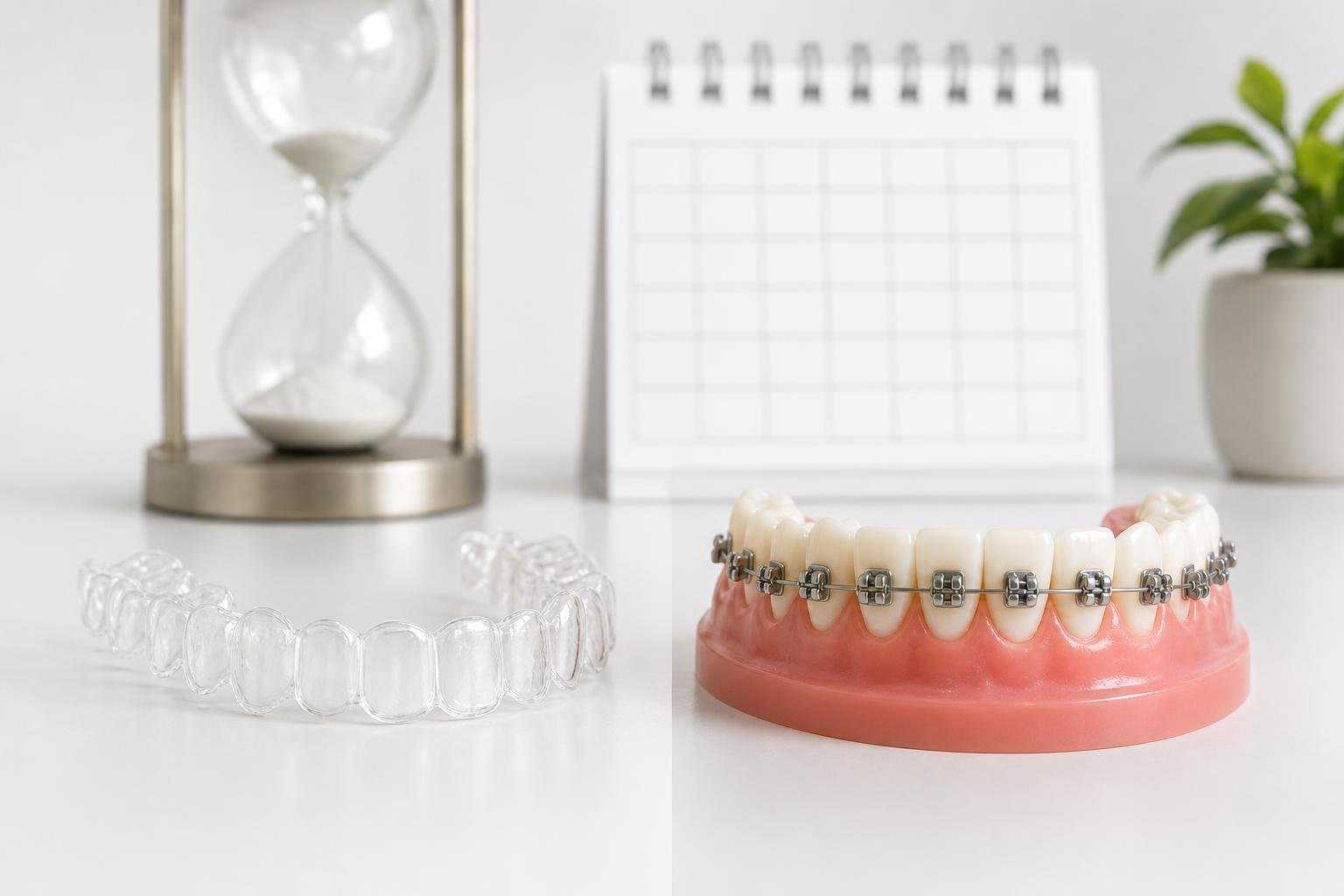
If you are comparing Invisalign treatment time with braces treatment time, the honest answer is that it depends on your teeth, your bite, and how consistently you follow the plan.
Neither option is automatically faster for every patient, but there are clear patterns that can help you understand what may suit your situation.
Key Takeaways
- Clear aligners can be an efficient option for mild to moderate alignment concerns when they are worn as directed.
- Braces are often more predictable for complex tooth movements, severe crowding, and significant bite issues.
- Invisalign or other clear aligner treatment can take longer if refinements are needed or aligners are not worn consistently.
- Your treatment time depends more on case complexity and clinical planning than on the appliance alone.
- A consultation with a specialist orthodontist is the best way to compare your likely treatment timeline.
Key Takeaways
- Clear aligners may be suitable for addressing mild to moderate alignment issues.
- Traditional braces remain highly predictable for complex tooth movements and severe malocclusions.
- Consistent daily wear is essential for keeping clear aligner treatment on schedule, as detailed in our The Complete Guide to Invisible Braces.
- Refinement phases are common with aligners and can extend the overall treatment timeline.
- Understanding the total investment for each option is easier with transparent pricing, which you can review on our pricing page.
Understanding Invisalign Treatment Time Compared with Braces
When we compare orthodontic options, the main question is not simply which system is faster. The better question is which system can move your teeth predictably for your particular bite.
Braces use metal or ceramic brackets bonded to the teeth and connected by an archwire. They work continuously because they stay fixed in place. Clear aligners, including Invisalign and Spark clear aligners, use a series of removable, custom-made trays that guide the teeth gradually from one stage to the next.
For some mild to moderate cases, clear aligners may offer a very efficient timeline. For more complex movements, braces can be more predictable because your orthodontist has direct control over each tooth throughout treatment.
Here is a simple way to think about it:
Mild Cases
For minor crowding, small spaces, or simple alignment issues, clear aligners may be a convenient and efficient option. Braces can also work very well, but some patients prefer aligners because they are removable and less noticeable.
Moderate Cases
For moderate cases, treatment time becomes more individual. Clear aligners may still be suitable, especially for patients who wear them consistently. Braces may be recommended if the tooth movements need more direct control.
Severe Cases
For severe crowding, complex bite problems, or difficult tooth rotations, braces are often the more predictable option. Clear aligners can still be useful in selected cases, but the timeline may be longer and may involve extra refinement stages.
You can read more about fixed appliance timelines in our guide to how long braces take.
What Affects Your Orthodontic Timeline?
Treatment time is not just about choosing Invisalign or braces. It is about your starting point, your goals, your biology, and how carefully the treatment is planned.
Case Complexity
The more complex the tooth movement, the more important predictability becomes. Mild crowding and spacing may respond well to clear aligners, while severe bite issues, significant rotations, and vertical tooth movements often suit braces better.
If you are still comparing the two systems, our pages on Invisalign and braces explain how each option works in more detail.
Aligner Wear Time
With braces, the appliance is fixed to your teeth and works all day. With clear aligners, you are in control because the trays are removable.
That flexibility is one of the reasons many adults and teens like aligners, but it also means consistency matters. If aligners are left out too often, the teeth may not track as planned. That can lead to delays, extra scans, or replacement trays.
In practical terms, clear aligners need to be worn for the recommended daily wear time and removed only for eating, drinking anything other than water, and cleaning your teeth.
Refinement Aligners
Many clear aligner cases include a refinement stage. This means your orthodontist takes a new digital scan and orders extra trays to fine-tune the final tooth positions or bite.
Refinements are not a failure. They are a normal part of many aligner plans. However, they can add several weeks or months to the overall treatment time, which is why the first estimate should always be treated as a guide rather than a guarantee.
When Braces May Be More Predictable
Clear aligners have improved a lot, especially with better materials and tooth-coloured attachments that help the trays grip the teeth. Even so, braces are still highly reliable for certain types of movement.
Braces may offer a more predictable timeline for:
- Severe crowding: When teeth are heavily overlapped and need careful space management.
- Complex rotations: Some teeth are harder for plastic aligners to grip and turn accurately.
- Vertical movements: Moving teeth up or down can be more predictable with fixed appliances.
- Significant bite issues: Deep bites, underbites, and other complex bite problems may need the continuous control of braces.
If your case involves these movements, braces may be the more direct path. For a deeper look at fixed appliances, see our metal dental braces guide.
Invisalign Treatment Time Versus Braces for Teens and Adults
Adults often like clear aligners because they are discreet and can be removed for meals, work, and social occasions. When adult patients wear them as directed, aligners can be a very practical option.
For teenagers, the decision depends on habits and responsibility. Some teens do very well with aligners. Others are better suited to braces because there is no need to remember trays, track wear time, or worry about losing them at school or sport.
Keeping Your Result After Treatment
Whether you choose clear aligners or braces, the final stage is the same: retention. Once your teeth are straight, they need support while the bone and gum tissues settle around their new positions.
Without retainers, teeth can slowly move back towards where they started. This is called relapse, and it can happen after any type of orthodontic treatment.
A retention plan may include:
- Fixed wire retainers: A thin wire bonded behind the front teeth to help hold them in place.
- Clear plastic retainers: Custom retainers worn as instructed, often overnight, to maintain the upper and lower arches.
Wearing retainers properly is one of the simplest ways to protect the time, effort, and money you have invested in treatment.
Choosing the Right Timeline for Your Smile
Choosing between clear aligners and braces is a personal decision, and it is best made after a proper orthodontic assessment. At NK Orthodontist, we have been helping Brisbane families with specialist orthodontic care since 1995.
Dr Nick personally sees every patient at every appointment, so your treatment is never delegated. From our Chermside and Spring Hill practices, we can talk you through the likely treatment time, comfort, cost, and predictability of each option.
We also offer transparent pricing with no hidden fees and interest-free payment plans, so you can make the decision with confidence.
If you are ready to compare your options, you can book a consultation with NK Orthodontist.
Frequently Asked Questions
Does Invisalign Take Longer Than Braces?
Invisalign may take longer or shorter than braces depending on your case. Mild to moderate cases with excellent aligner wear can progress efficiently, while complex cases may be faster or more predictable with braces.
Is the Final Result with Invisalign as Good as Braces?
For many mild to moderate cases, clear aligners and braces can both achieve excellent results. For complex bite problems or difficult tooth movements, braces may give your orthodontist more direct control.
Why Do Clear Aligners Sometimes Need Refinements?
Refinements help fine-tune tooth positions when the first set of aligners has not achieved every planned movement. They are common in aligner treatment and can add extra time to the overall plan.
How Many Hours a Day Do I Need to Wear Clear Aligners?
You need to wear clear aligners for the daily wear time recommended by your orthodontist. They should usually only come out for eating, drinking anything other than water, and cleaning your teeth.
Can Clear Aligners Correct Severe Bite Issues as Quickly as Braces?
Sometimes, but not always. Braces are often more predictable for severe bite issues because they apply continuous force and allow detailed control of tooth movement.
Do I Need to Wear a Retainer After Clear Aligner Treatment?
Yes. Retainers are needed after any orthodontic treatment, including clear aligners and braces. They help keep your teeth in their new positions and reduce the risk of relapse.
How Do I Maintain My Clear Aligners During Treatment?
Rinse your aligners with lukewarm water, brush them gently with a soft toothbrush, and clean your teeth before putting them back in. Avoid hot water, as it can distort the plastic.
How Does Case Complexity Affect Clear Aligner Predictability?
Clear aligners are often predictable for mild crowding and spacing. More complex movements, such as severe rotations or vertical changes, may be less predictable and may suit braces better.


