

Orthodontic Options for Teens: Start With the Right Plan
If you are comparing orthodontic options for your teen, the right starting point is a personalised assessment of their teeth, bite, jaw growth, daily routine, and appliance suitability.
Key Takeaways
- Ask Dr Nick to assess your teenager’s dental development, jaw growth pattern, and appliance suitability before choosing clear aligners, ceramic braces, or metal braces.
- Discuss school sport, music, photos, and daily routines early so the treatment plan can account for the parts of life your teenager cares about.
- Compare fixed appliances with removable clear aligners by looking at responsibility, cleaning routines, and how consistently your teen can manage the appliance.
- Plan retention from the beginning, including clear removable plastic retainers made in-house or a fixed wire retainer behind the lower front teeth where suitable.
- Review transparent treatment pricing during clinical planning rather than relying on general estimates.
About the Author
I am Dr Nick, a Specialist Orthodontist with more than 30 years in private practice and experience caring for more than 11,500 patients. I wrote this guide to help parents and teenagers understand orthodontics for teens in a practical, conversational way before an initial consultation.
Choosing the Right Teen Orthodontic Plan
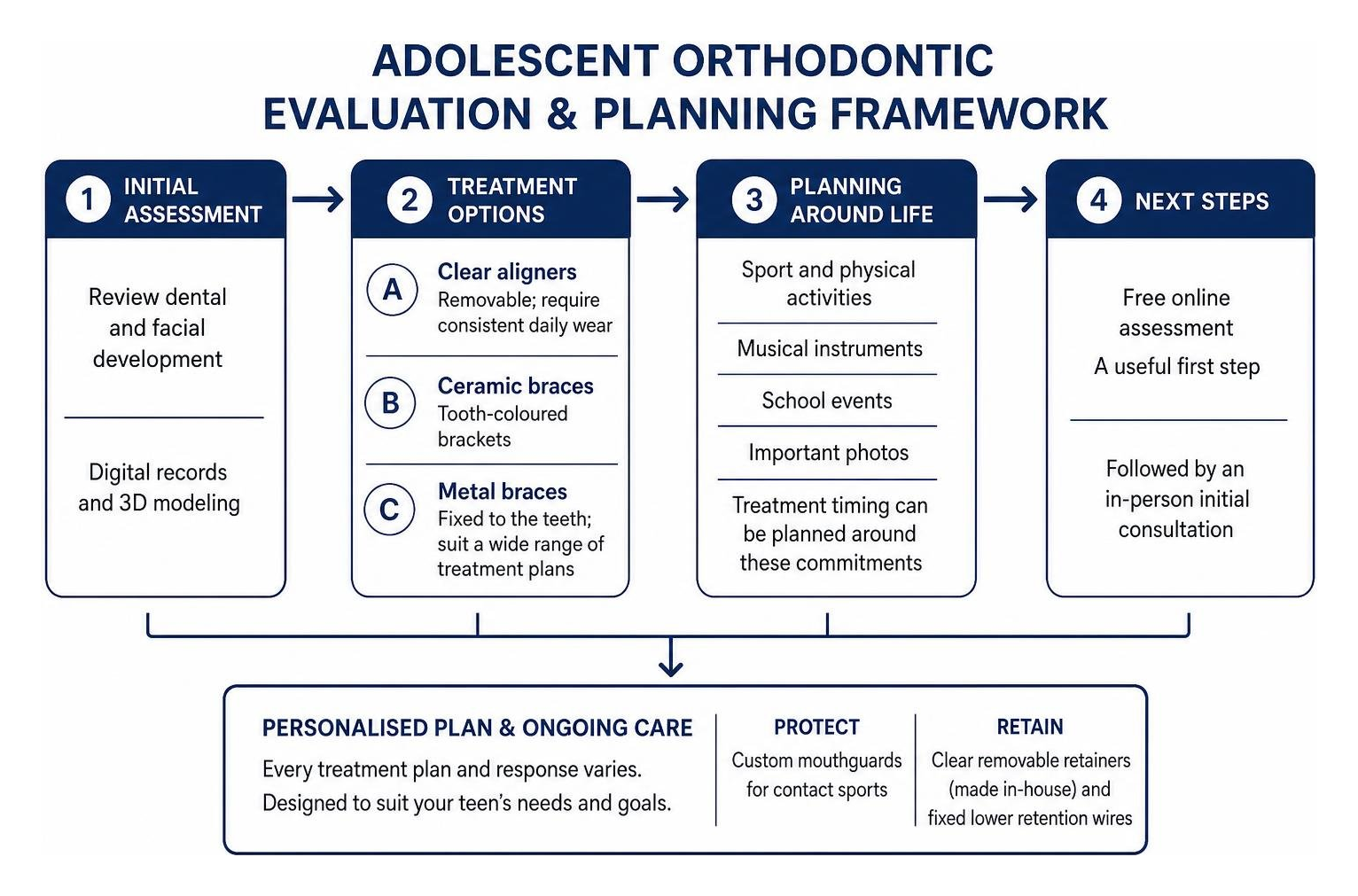
A teen orthodontic plan should fit the patient, not the other way around. During an initial consultation, I assess dental development, bite relationships, jaw growth, oral hygiene, and how ready your teenager feels to manage an appliance.
Families usually compare three main options:
- Clear aligners, removable trays that need consistent daily wear.
- Ceramic braces, fixed tooth-coloured brackets that are less noticeable than metal brackets.
- Metal braces, fixed brackets that may suit a wide range of treatment plans.
It also helps to discuss sport, musical instruments, school events, and important photos early. Treatment timing can often be planned around these commitments, though every treatment plan and response varies.
A free online assessment can be a useful first step before arranging an in-person initial consultation.
Why the Teenage Years Can Suit Orthodontic Care
Adolescence can be a practical stage for orthodontic care because many adult teeth have arrived and facial growth is still developing. Assessment during this stage allows a specialist orthodontist to guide alignment alongside natural biological changes.
Every teenager’s dental readiness is different. I look at the whole picture before recommending when active treatment may be suitable.
Assessing Timing and Growth Factors
Growth changes during the secondary school years can influence how a treatment plan is designed. During an initial clinical evaluation, I assess the eruption stage of the second molars, the relationship between the upper and lower dental arches, and overall facial symmetry.
Digital modeling for clinical planning allows us to map the positioning of each tooth. These 3D digital setups help our team design customised mechanics for the teenager’s individual growth pattern without presenting them as a guaranteed preview of results.
Managing Extracurricular Activities and Sports
Teenagers often juggle sport, drama, music, and school milestones. Orthodontic treatment can be planned with those routines in mind.
Teen athletes in contact sports may need mouth protection. For patients wearing fixed braces, custom mouthguards can be made to fit over brackets and cushion the lips and cheeks during impact. Teens using clear aligners can remove their aligner trays for training or games and wear their usual sports mouthguard.
Musicians playing wind or brass instruments may notice an adjustment period with new appliances. Clear aligners offer flexibility for important performances, and students with fixed brackets usually adapt as their lips and playing technique adjust.
Comparing Modern Orthodontic Treatment Options
Families can choose from appliance systems designed for different clinical needs and personal preferences. Reviewing an Invisalign vs braces guide can help you see how different systems work in daily life.
| Feature | Clear aligners (Invisalign or Spark) | Ceramic braces | Metal braces |
|---|---|---|---|
| Appliance type | Removable clear plastic trays | Fixed tooth-coloured brackets | Fixed high-grade stainless steel brackets |
| Visibility | Low visual profile | Subtle aesthetic appearance | Visible metallic design |
| Maintenance | Removed for meals and brushing | Dedicated brushing around brackets | Dedicated brushing around brackets |
| Daily routine | Requires consistent wear as directed | Works continuously once fitted | Works continuously once fitted |
| Customisation | Clear, discreet material | Clear or matched elastics | Coloured elastic modules |
Clear Aligners and Invisalign for Teenagers
Clear aligners provide a removable approach that can suit some busy school routines. Systems like Invisalign and Spark use a series of custom-moulded plastic trays that apply planned pressure to guide tooth movement.
Parents often appreciate reviewing a cheat sheet to modern teen aligners to understand daily compliance requirements. Modern teen aligners may include compliance indicator dots that fade as the trays are worn, helping families monitor whether the appliances stay in place as directed. Aligners should be removed when eating or drinking anything other than plain cool water.
Fixed Metal and Ceramic Braces for Teenagers
Fixed appliances remain a common foundation of orthodontic care. High-grade stainless steel brackets can support planned tooth movement continuously because they do not rely on a teenager remembering to wear removable trays.
A detailed teen braces guide can help families understand the difference between traditional metal brackets and ceramic alternatives. Ceramic braces use translucent materials that blend with natural tooth enamel, which may appeal to adolescents who prefer a less noticeable option. Metal braces also let teenagers customise their braces at adjustment visits with coloured elastic modules.
Managing Daily Life and Appliance Maintenance
Consistent oral hygiene helps protect gum health and tooth enamel throughout treatment. Fixed brackets create small spaces where food debris can collect, so interdental brushes, floss threaders, and electric toothbrushes can be useful daily tools.
Teenagers wearing fixed appliances should avoid very hard, sticky, or chewy foods such as whole nuts, hard caramels, and popcorn kernels to help reduce the chance of dislodging brackets. Clear aligner wearers can brush and floss normally after meals before placing their trays back over clean teeth. Orthodontic wax can help protect soft oral tissues if an appliance edge rubs against the inner lip or cheek.
Handling Broken Brackets and Lost Aligners
Appliance mishaps sometimes happen during school days or sports practice. When a bracket loosens or a wire shifts, a small piece of orthodontic wax over the sharp area can keep the mouth more settled until you visit our practice.
If your teen misplaces a clear aligner tray during lunch or on a school trip, contact our practice promptly. Depending on where your teen is in the current aligner cycle, I will advise whether to step back to the previous tray or move forward to the next scheduled set so treatment can continue as planned.
Long-Term Retention Planning
Active tooth movement is one phase of orthodontic care. Once appliances are removed, teeth need support while surrounding bone tissue and periodontal ligaments stabilise.
Our practice provides retention protocols to support long-term stability:
- Clear removable plastic retainers made in-house: These transparent appliances fit over the full arch and are worn primarily overnight to help keep teeth in their target positions.
- Fixed wire retainer behind the lower front teeth: A customised wire bonded to the back of the front teeth provides ongoing support in an area that can be prone to later movement.
Routine retention checks allow us to monitor appliance fit and dental stability into young adulthood.
Planning Teen Orthodontic Care with Dr Nick
Choosing orthodontic treatment for your teenager involves balancing clinical needs, daily schedules, and long-term dental health. At NK Orthodontist in Chermside, I personally assess every patient and manage each adjustment appointment so families receive consistent, attentive care.
With over 30 years of clinical experience, our team creates practical treatment plans built around your teen’s real life. Book an in-person consultation to explore suitable options for your teenager.
Frequently Asked Questions
What is the most suitable age to begin treatment?
The most suitable time depends on dental development, not a specific age. An early evaluation allows me to monitor developmental milestones, assess alignment concerns, and recommend when active care may be appropriate.
How are appliances managed during school milestones or sports?
Treatment planning can often account for major milestones such as formal events, graduations, or sports seasons. Clear aligners may be removed briefly for special photos or performances when clinically appropriate, and fixed appliances can be paired with custom orthodontic mouthguards for sport.
What financial arrangements exist for adolescent treatment?
Many families prefer to discuss payment arrangements before choosing a treatment plan. NK Orthodontist can explain available payment arrangements during your consultation, and private health insurance policies with orthodontic coverage may provide applicable rebates.
Where can I learn more about orthodontic care?
For general background information, Healthdirect Australia provides patient information on orthodontics. Your own suitability still needs to be assessed by a specialist orthodontist.


